Category: Famous Exoplanets

Kapteyn’s b

Kapteyn’s b is located 12.8 light-years (3.91 parsecs) from our solar system and was discovered in 2014 orbiting its host star Kapteyn’s. The apparent magnitude of the host star is 18.8 and the absolute magnitude is 10.8. Kapteyn’s is about 0.3 the mass of our sun and has about 0.3 the radius. Its surface temperature is 3550 K and is a spectral dM1 type star. The planet Kapteyn’s b orbits the star every 48.6 days, its orbital radius is 0.17 SEAU.


For more information on Kapteyn’s b, please visit the ExoKyoto Database:

http://www.exoplanetkyoto.org/exohtml/Kapteyn’s_bJP.html

tau Cet e

tau Cet e is located 11.9 light-years (3.95 parsecs) from our solar system and was discovered in 2012 orbiting its host star tau Cet. The apparent magnitude of the host star is 3.5 and the absolute magnitude is 5.7. tau Cet is about 0.8 the mass of our sun and has about 0.8 the radius. Its surface temperature is 5344 K and is a spectral G8.5V type star. The planet tau Cet e orbits the star every 162.9 days, its orbital radius is 0.54 SEAU


For more information on tau Cet e, please visit the ExoKyoto Database: 

http://www.exoplanetkyoto.org/exohtml/tau_Cet_eJP.html

K2-9b

During the K2 Kepler Mission, 31 stars were discovered that potentially had 36 orbiting planets. After extensive observations using automatic transit analysis, 21 exoplanets, including 17 new discoveries, were confirmed to be real planets, including K2-9b. K2-9b is a M2.5 ± 0.5, 110 ± 12 pc dwarf star with a radius of 2.25 (+0.53-0.96) R⊕ and an orbital period of 18.4498 days. The temperature of K2-9b is estimated to be less than 500 K, which means that the exoplanet receives about the same amount of solar radiation as the Earth. However, according to readings from the ultraviolet space telescope GALEX, UV radiation from its host star is strong enough to affect the planet’s atmosphere and it is improbable that the environment would be hospitable to life. There is still a lot to learn about this exoplanet, especially because it has a low temperature and is around the size of Earth or Neptune.

(Nami Kimura)
References:
Two Small Temperate Planets Transiting Nearby M Dwarfs in K2 Campaigns 0 and 1
Schlieder, Joshua E et al.
Publication:
The Astrophysical Journal, Volume 818, Issue 1, article id. 87, 15 pp. (2016).
Pub Date: February 2016

Kepler-90 i (Kepler 90 System)


Kepler-90 is a G-type main-sequence star located in the Lyra constellation, about 2545 light years from Earth.
It has a mass and volume are about 1.13 and 1.2 times that of our sun. Our sun has a surface temperature of about 5778 Kelvin and it is around 4.6 billion years old, while Kepler-90 has a surface temperature of about 5930 Kelvin and is an estimated 2 billion years old.

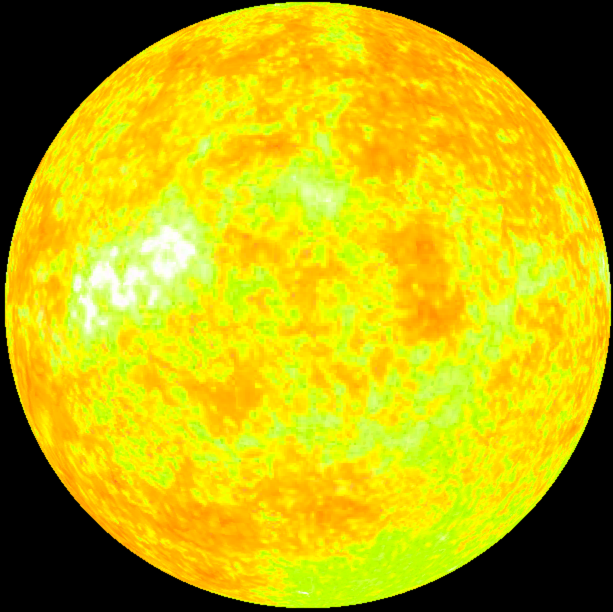
<Fig. 1 Imaginary Image of Kepler-90: Image credit Fuka Takagi & Yosuke A. Yamashiki>

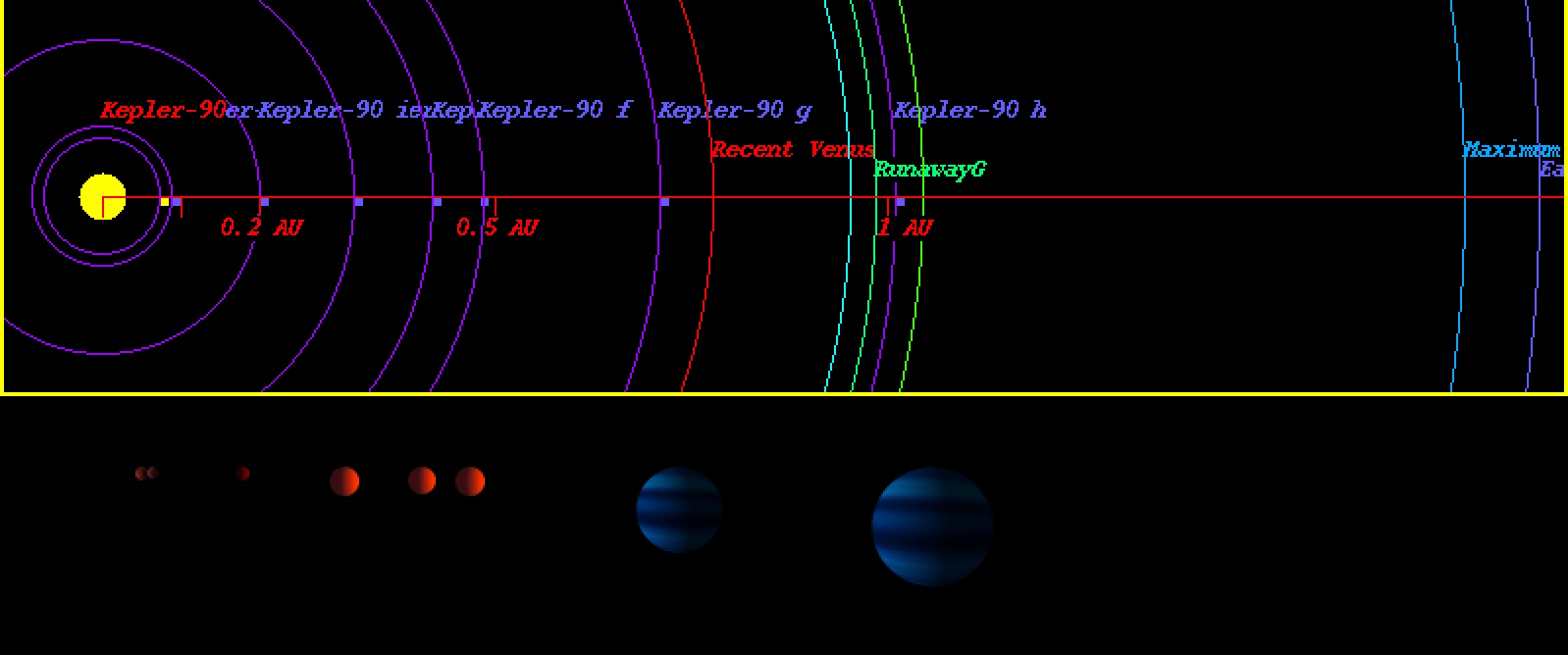
A remarkable discovery found that Kepler-90 also has eight planets in its solar system, the same as our own. This makes Kepler-90 hold the record for most planets orbiting a star that we have discovered yet.

<Fig. 2 Planets Orbiting Kepler-90, Using the ExoKyoto Application>

NASA and Google announced n November 14, 2017, that they discovered Kepler-90i, the eighth planet in the Kepler-90 system. Kepler-90i was discovered by analyzing data from the Kepler Space Telescope using a new machine learning system developed by Google. NASA also discovered Kepler-80g using the same system.

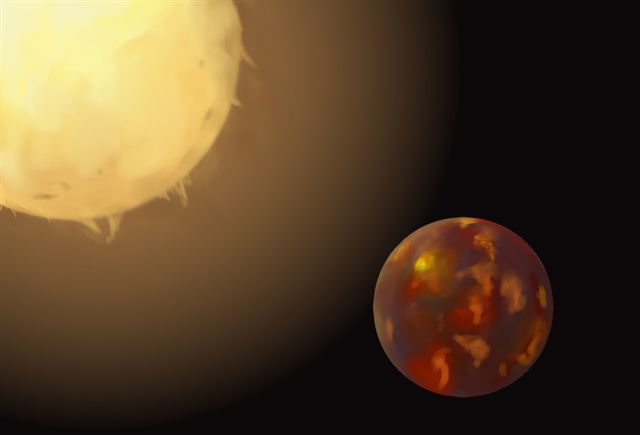
<Fig. 3 Imaginary Image of Kepler-90i Image Credit Ryusuke Kuroki, Yosuke A. Yamashiki>

Kepler-90’s planetary system structure is similar to that of our own solar system. All of the six inner planets are rocky planets, slightly larger than Earth or smaller than Neptune, and the two outer planets are large gas giants. The outermost planet, Kepler-90h, is a Jupiter-sized planet that orbits the host star at the same distance (1.01 AU) as the Earth to the Sun, orbiting the star in about 331 days.

Of course, there are slight differences from our solar system. The outermost planet has an orbital radius roughly equal to that of Earth, and all eight planets are squeezed into a much smaller area than the planets in our solar system. The orbits of the six inner planets are particularly small, for instance, while Mercury has an orbital period of 88 days, Kepler-90i orbits Kepler-90 in just 14.4 days. Consequently, the surface temperature of Kepler-90i can reach 640 Kelvin, and life on the surface is thought to be impossible.

Kepler90Movie

<Movie 1 Kepler-90 and its Planetary Orbits>

It is widely thought that the planets in the Kepler-90 system were once spread out, but for some reason have now moved closer to the host star in their current orbit.

AI produced by Google discovered the new planet by using a neural network of mathematical models, similar to how the human brain works, which identifies a planet’s signal with incredible accuracy. The AI already discovered two exoplanets after analyzing only 670 of the approximately 200,000 celestial objects observed by the Kepler Space Telescope. More exoplanets are expected to be discovered by this method in the near future.

<村嶋慶哉・山敷庸亮>

For more information on Kepler-90i, please visit the ExoKyoto Database:

http://www.exoplanetkyoto.org/exohtml/Kepler-90_iJP.html

 For more information about the host star Kepler-90, please visit the ExoKyoto Database:

http://www.exoplanetkyoto.org/exohtml/Kepler-90JP.html

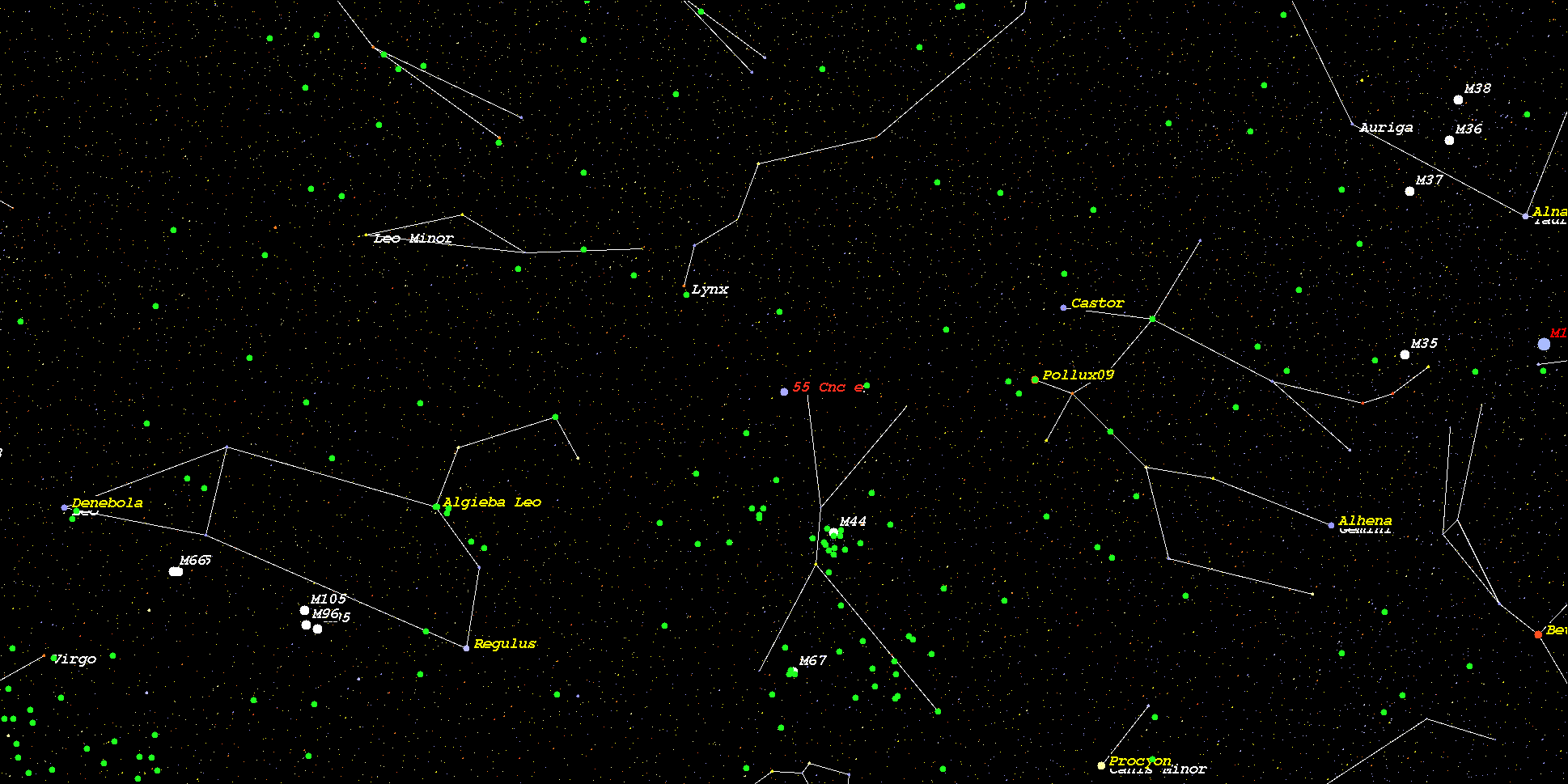
55 Cancri e

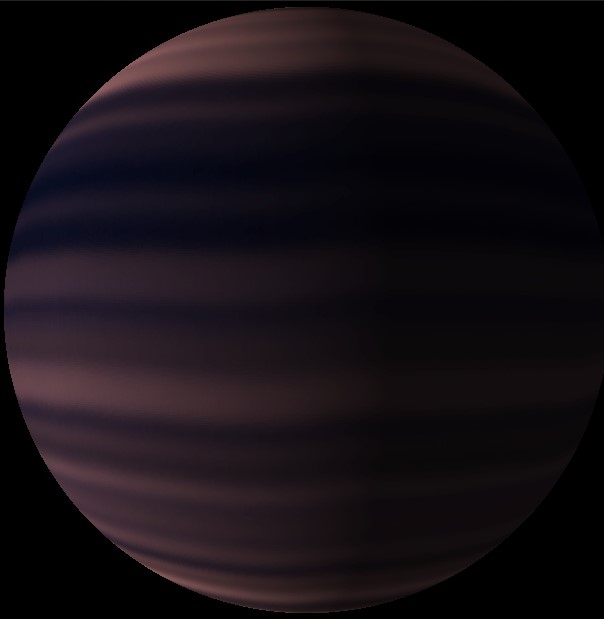
55 Cancri e is a super-Earth — about twice our planet’s size — that zooms around its star in 18 days. It has a surface temperature of nearly 4,900 degrees Fahrenheit (2,700 degrees Celsius). For a while, it was dubbed the “diamond planet” because scientists suggested that it was composed of diamonds and graphite. While that theory is not as popular today, the planet still remains an interesting object of study due to its high density and its very close proximity to its parent star. Several follow-up studies have yielded more insights about its super-hot surface, as well as its atmosphere.

(Credit: Rina Maeda & SGH Moriyama High School)

Astronomers discovered the planet in 2004 after looking at the spectrum of its parent star, 55 Cancri A, one of two stars in a binary system about 40 light-years from Earth in the constellation Cancer. There are at least four other planets in the same system, mostly discovered before 55 Cancri e. The team (led by the University of Texas at Austin’s Barbara McArthur) discovered subtle tugs on the parent star that could be explained by the presence of yet another planet. While the planet’s existence was challenged by a second research team in 2005, a separate team in 2006 confirmed it.

(文責:高木風香)
(修正担当:野津湧太)

For more information about 55 Cancri e, please visit the ExoKyoto Database:
http://www.exoplanetkyoto.org/exohtml/55_Cnc_eJP.html

Beta Pictoris b

<Imaginary image of Beta Pictoris b>

Beta Pictoris b is located in the Pictoris constellation about 63 light-years from Earth. It orbits the star Beta Pictoris at 13.18 astronomical units.

The planet is about 1.65 times the size and 7 times the mass of Jupiter, it was discovered by direct imaging using European Southern Observatory’s Very Large Telescope.

Beta Pictoris b was discovered by using the Doppler effect on its rotation. As the planet moves further away from the observer, the wavelength of light becomes longer, and as the planet moves closer, the wavelengths become shorter.

Observing this change in wavelength (Doppler shift), we know that Beta Pictoris’ rotation cycle is about 8 hours, and its speed is around 100,000km/hr.

In comparison, Earth’s rotation speed is 1,700km/hr, and Jupiter’s is 47,000km/hr, which is the fastest in the solar system.

Because the planets in Beta Pictoris b’s solar system all tend to be this fast, it is implied that the relationship of speed and mass for this planet could be universal.

Beta Pictoris is a young star at only around 20 million years old, there is a debris disk around the star at about 1000 astronomical units, leading scientists to believe the system is still in progress.

Taking into consideration the passage of time and the planet’s contractions due to cold, the rotation is expected to be very fast.

Also, the planetary systems have 493 exo-comets that were discovered by a research team in France, and each comet has various trajectories that are affected by the planet’s large size and gravitational field. It is thought that the comets were originally one celestial body that broke apart into two groups of comets.

One group of comets released gas and dust due to their vigorous movement, causing them to fly close to the host star, which means that any ice present would be dried up.

The other group of comets move the same way, orbiting the planet, which means they are thought to be from one celestial body that broke apart.

Beta Pictoris is a young system that is still evolving.

What could have been happening in our solar system 45 billion years ago? This is why Beta Pictoris a subject of extremely important research.

<文責:山中陽裕>

References:
http://www.eso.org/public/news/eso1414/
http://www.nature.com/nature/journal/v509/n7498/full/nature13253.html?foxtrotcallback=true
http://www.eso.org/public/news/eso1432/