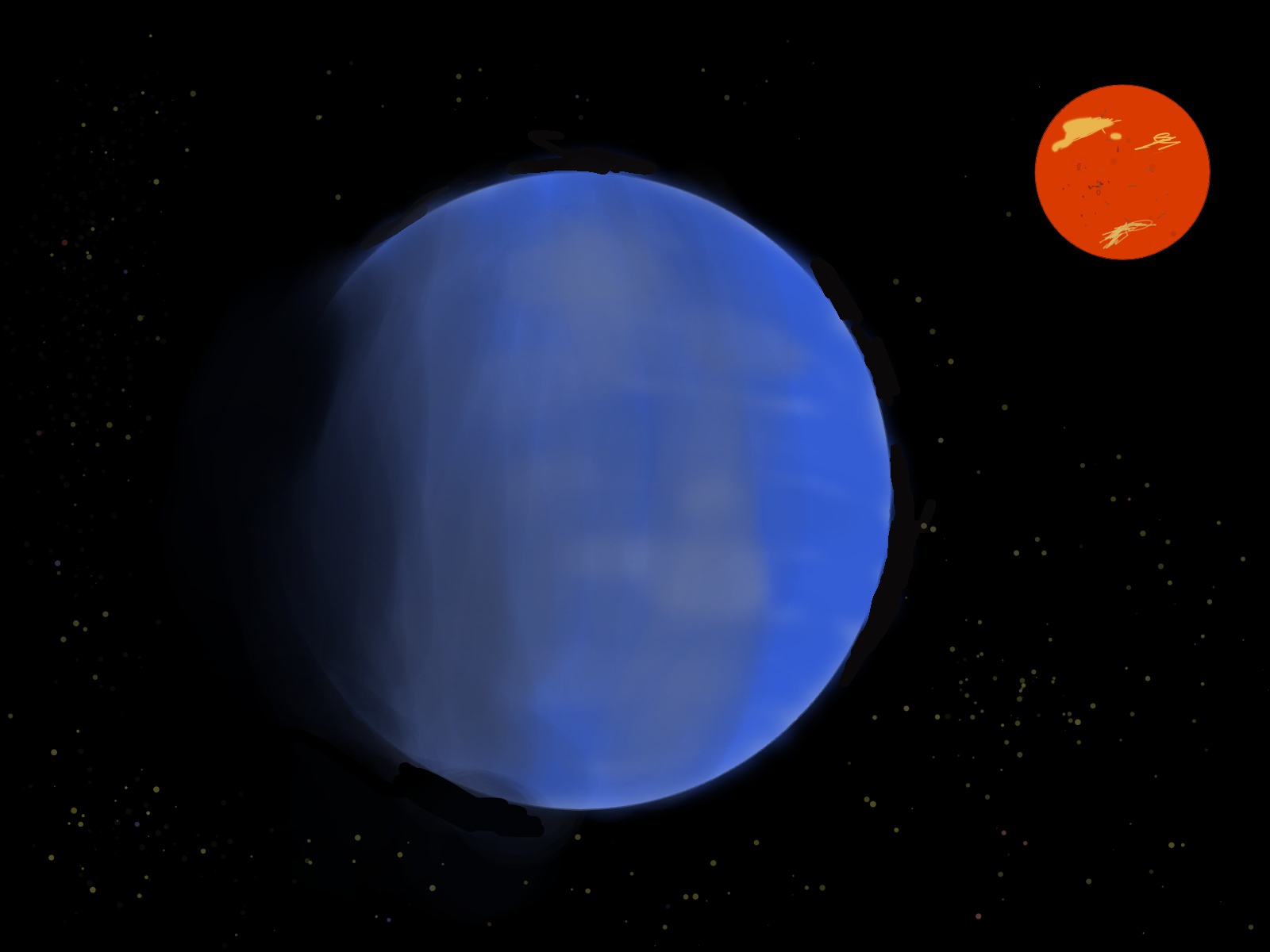
Kepler-1544 b

Kepler-1544 b

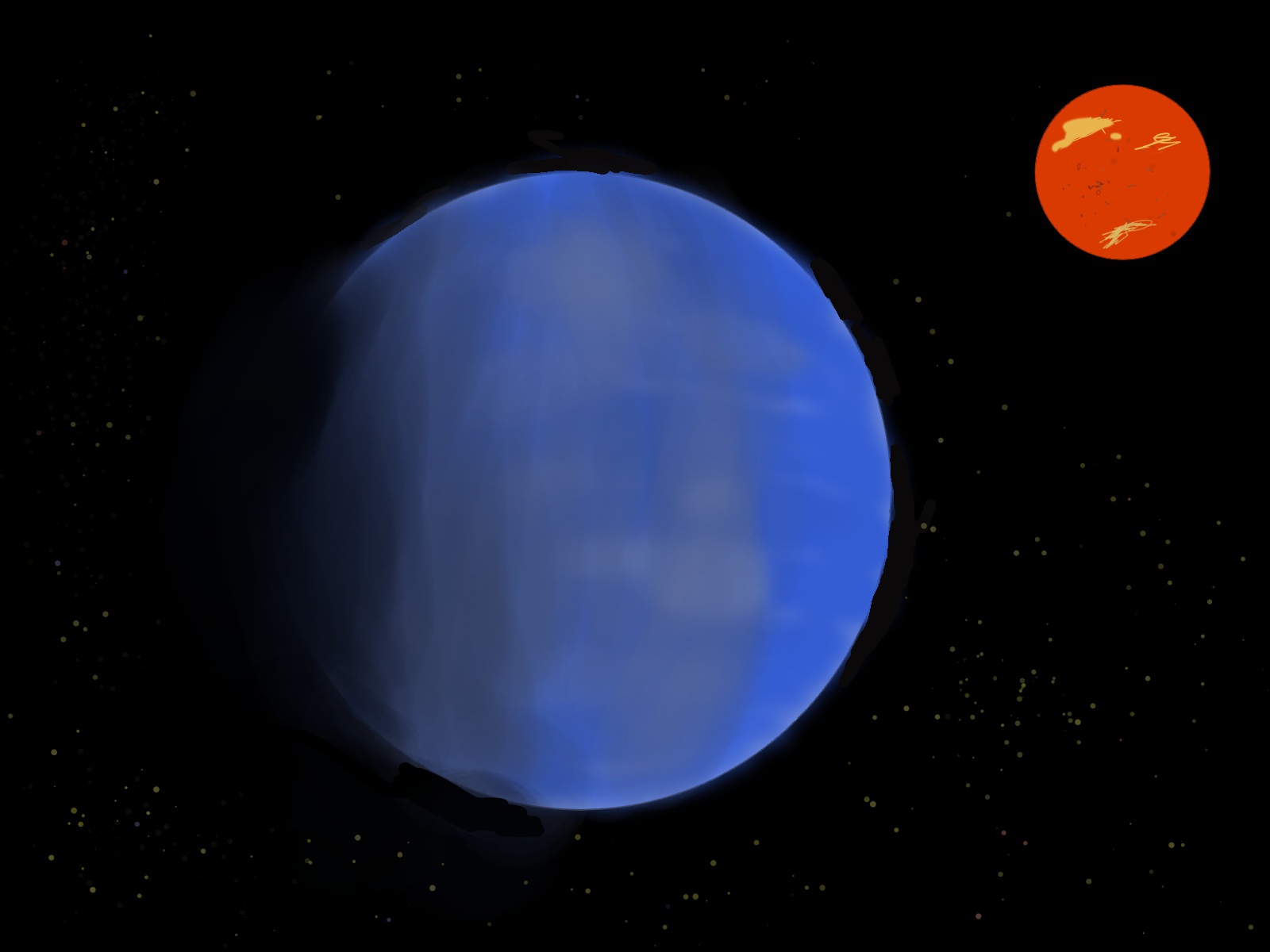
<Imaginary Picture of Kepler-1544 b, © 2018 ExoplanetKyoto- Chise Hatsuoka, SGH Moriyama High School>

[Imaginary Picture of Kepler-1544 b, Fuka Takagi & Yosuke A. Yamashiki ]

Kepler 1544 b is located 1138.3 light-years (349 parsecs) from our solar system and was discovered in 2016 orbiting its host star Kepler 1544. The apparent magnitude of the host star is 12.5 and the absolute magnitude is 4.8. Kepler 1544 is about 0.8 the mass of our sun and has about 0.7 the radius. Its surface temperature is 4886 K and is a spectral K2 type star. The planet Kepler 1544 b orbits the star every 168.8 days, it’s orbital radius is 0.56 SEAU.

Kepler 1544 b has a radius that is thought to be about 1.8 times that of the Earth, and its black body temperature (248 K), which was calculated assuming an albedo of 0.3, is almost that of the Earth (255 K). This might suggest the presence of continents and water. The following imaginary video was posted by PlanetExplorer and details the  surface of this planet, but what is it really like?

For more information about Kepler-1544 b, please visit the ExoKyoto Database:
http://www.exoplanetkyoto.org/exohtml/Kepler-1544_bJP.html

Kepler-1593 b

Kepler-1593 b is located 2462.5 light-years (755 parsecs) from our solar system and was discovered in 2016 orbiting its host star Kepler-1593. The apparent magnitude of the host star is 14.2 and the absolute magnitude is 4.8. Kepler-1593 is about 0.8 the mass of our sun and has about 0.8 the radius. Its surface temperature is 4995 K and is a spectral K2 type star. The planet Kepler-1593 b orbits the star every 174.5 days, it’s orbital radius is 0.57 SEAU.

For more information about Kepler-1593 b, visit the ExoKyoto Database:

http://www.exoplanetkyoto.org/exohtml/Kepler-1593_bJP.html

Kepler-1606 b

(Imaginary Picture of Kepler-1606 b by Mr. Daichi Ogawa, SGH Moriyama High School)

Kepler-1606 b is located 2870.2 light-years (880 parsecs) from our solar system and was discovered in 2016 orbiting its host star Kepler-1606. The apparent magnitude of the host star is 13.9 and the absolute magnitude is 4.2. Kepler-1606 is about 0.9 the mass of our sun and has about 0.9 the radius. Its surface temperature is 5422 K and is a spectral G7 type star. The planet Kepler-1606 b orbits the star every 196.4 days, it’s orbital radius is 0.64 SEAU.

Kepler 1606 b has an estimated radius of 2.073 times the Earth (0.185 that of Jupiter). Although the actual weight is unknown,  if it is a rocky planet, it should be more than 10 times that of the Earth, but due to its size, it is considered to be a Neptune-type planet. ExoKyoto estimates that it weighs 5.1985 times the Earth. It is located in the habitable zone, but it is slightly inside the runaway greenhouse limit, so there is a possibility that if it has a sea, it might have evaporated.

If you would like to know more about Kepler-1606 b, please see Exokyoto’s database page below.

http://www.exoplanetkyoto.org/exohtml/Kepler-1606_bJP.html

Kepler-1638 b

Kepler-1638 b is one of 1,284 exoplanets discovered (2016) by NASA’s Kepler Space Telescope, which looks for exoplanets using the transit method. This method also estimates the size of the exoplanet when it is discovered (for more information on the transit method -> http://www.exoplanetkyoto.org/study/method/). Kepler-1638 b has a radius 1.87 times that of the Earth (Molton et al. 2016) and the orbital length radius (distance from the host star, Kepler-1638) of the planet Kepler-1638 b is about 0.745 AU (Torres et al. 2016). This led to the thought that Kepler-1638 b could be a planet very similar to Earth when focusing on the size and orbital length radius.

The host star, Kepler-1638, is also considered to be similar to our Sun. Its radius is 0.95 times larger than the Sun, its mass is 0.97 times greater, and its temperature is 5,710 K, almost the same as the surface of the Sun (5,772 K.) Does Kepler-1638 have an atmosphere or a magnetic field? Could Kepler-1638 b be an Earth-like planet and have the possibility of sustaining life?

For more information about Kepler-1638 b, please visit the ExoKyoto Database:
http://www.exoplanetkyoto.org/exohtml/Kepler-1638_bJP.html

GJ 163c

GJ 163 c is located 48.9 light-years (15.0 parsecs) from our solar system and was discovered in 2012 orbiting its host star GJ 163. The apparent magnitude of the host star is 11.8 and the absolute magnitude is 10.9. GJ 163  is about 0.4 the mass of our sun and has about 0.4 the radius. Its surface temperature is 3500 K and is a spectral M3.5 type star. The planet GJ 163 c orbits the star every 25.6 days, it’s orbital radius is 0.13 SEAU.

For more information about GJ 163 c, please visit the ExoKyoto database:

http://www.exoplanetkyoto.org/exohtml/GJ_163_cJP.html

GJ 180 c

GJ 180 c was discovered in 2014 orbiting its host star GJ 180. The apparent magnitude of the host star is 10.9 and the absolute magnitude is 25.0. GJ 180  is about 0.4 the mass of our sun and has about 0.4 the radius. Its surface temperature is 3371 K and is a spectral M2V type star. The planet GJ 180 c orbits the star every 24.3 days, it’s orbital radius is 0.13 SEAU.


For more information about GJ 180 c, please visit the ExoKyoto Database:
http://www.exoplanetkyoto.org/exohtml/GJ_180_cJP.html