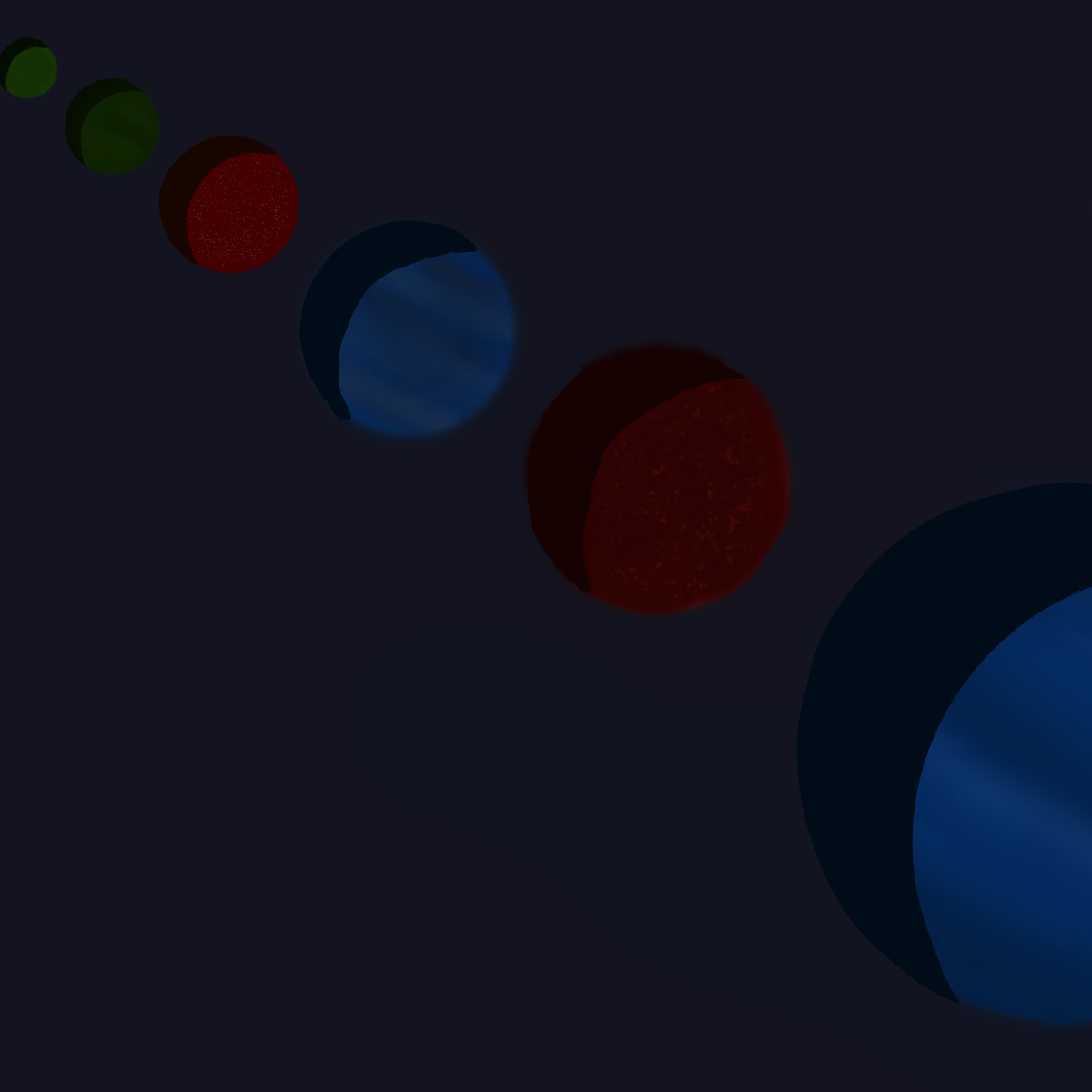
Imaginary Picture of Exoplanets of HD 110067 (Yuna Watanabe)

Imaginary Picture of HD 110067
This star is HD 110067. The star HD 110067 is located 105.1 light-years (32.2 parsecs) from the Solar System. The star HD 110067 has an apparent magnitude of 8.4 and an absolute magnitude of 5.9. It has 0.8 times the mass and 0.8 times the radius of the Sun. Its surface temperature is 5,266 Kelvin, and its spectral type is K0V.
HD110067 is an 8th-magnitude K-type main-sequence star with a mass and radius of just under 80% that of the Sun, located approximately 100 light-years from Earth in the direction of the constellation Coma Berenices. A K-type main-sequence star is a main-sequence star with a spectral class of K and a luminosity class of V, in which hydrogen fusion occurs in the core; such stars are also known as orange giants.
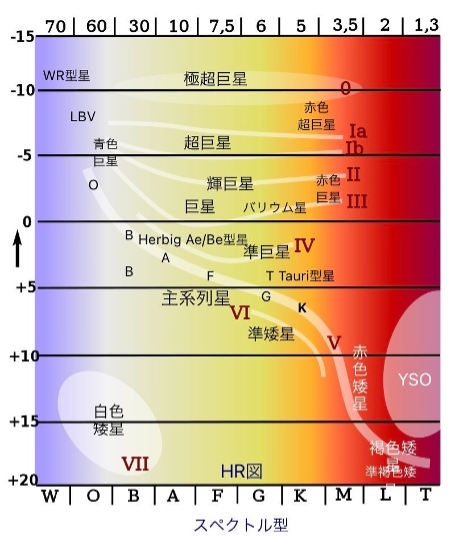
From Wikipedia
In 2023, observations using the transit method confirmed that six exoplanets orbit this star. The transit method is an observational technique for detecting planets by detecting periodic changes in the host star’s brightness caused by a planet periodically passing in front of it as it orbits. HD 11067 is the brightest known star to host at least four transiting planets. Although not confirmed, it is estimated to be approximately 8.1 billion years old, with a metallicity of 63% that of the Sun. Furthermore, while HD 11067 is its designation in the Henry Draper Catalog, this star has also been assigned the catalog number TOI-1835 as a TESS Object of Interest (TOI) because potential exoplanets orbiting it were detected by observations from TESS, the Transiting Exoplanet Survey Satellite.
Through a global collaborative observation campaign involving space-based and ground-based telescopes, six transiting planets have been discovered orbiting the star HD 110067, located approximately 100 light-years from the Solar System. Furthermore, these six planets exhibit a “lucid ratio” relationship, in which the orbital periods of all adjacent pairs of planets are expressed as simple integer ratios.
The planets orbiting inside HD 110067 are known as TOI-1835.03 (later HD 110067b) and TOI-1835.04 (later HD 110067c). In addition, ESA discovered HD 110067d, which orbits with a period of approximately 20.52 days, and subsequently found HD 110067e, which has an orbital period of approximately 30.79 days and is in a 2:3 orbital ratio with HD 110067d. Subsequently, the existence of HD 110067 f, with an orbital period of approximately 41.06 days, and HD 110067 g, with an orbital period of approximately 54.77 days, was confirmed. HD 110067 e and HD 110067 f, as well as HD 110067 f and HD 110067 g, all have orbital periods in a 3:4 ratio, and when considering the orbital period ratios of all six planets, they form a 9:12:16:24:36:54 ratio.
This planetary system is not only a valuable model for understanding how planets form, but it is also expected that observations of the atmospheres of each planet will lead to a better understanding of the processes by which planets acquire atmospheres, as well as the effects of starlight on atmospheric escape and chemical evolution.
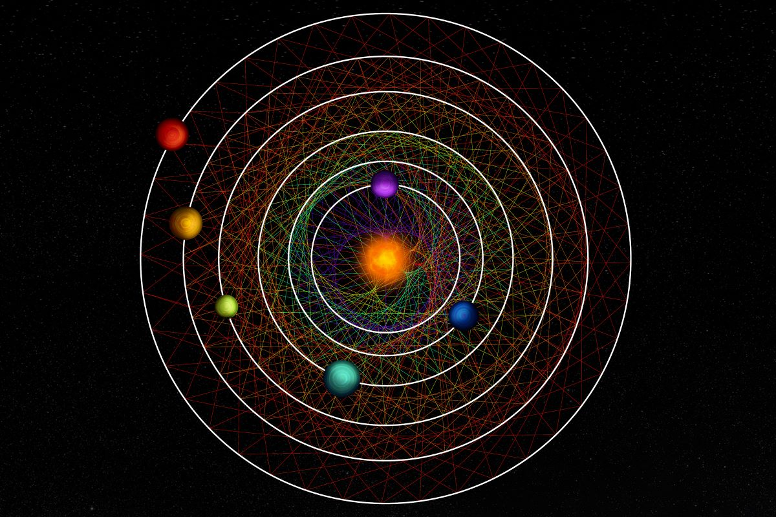
A geometric pattern formed by lines connecting the positions of the six discovered planets at regular intervals
Credit: Thibaut Roger/NCCR PlanetS, CC BY-NC-SA 4.0
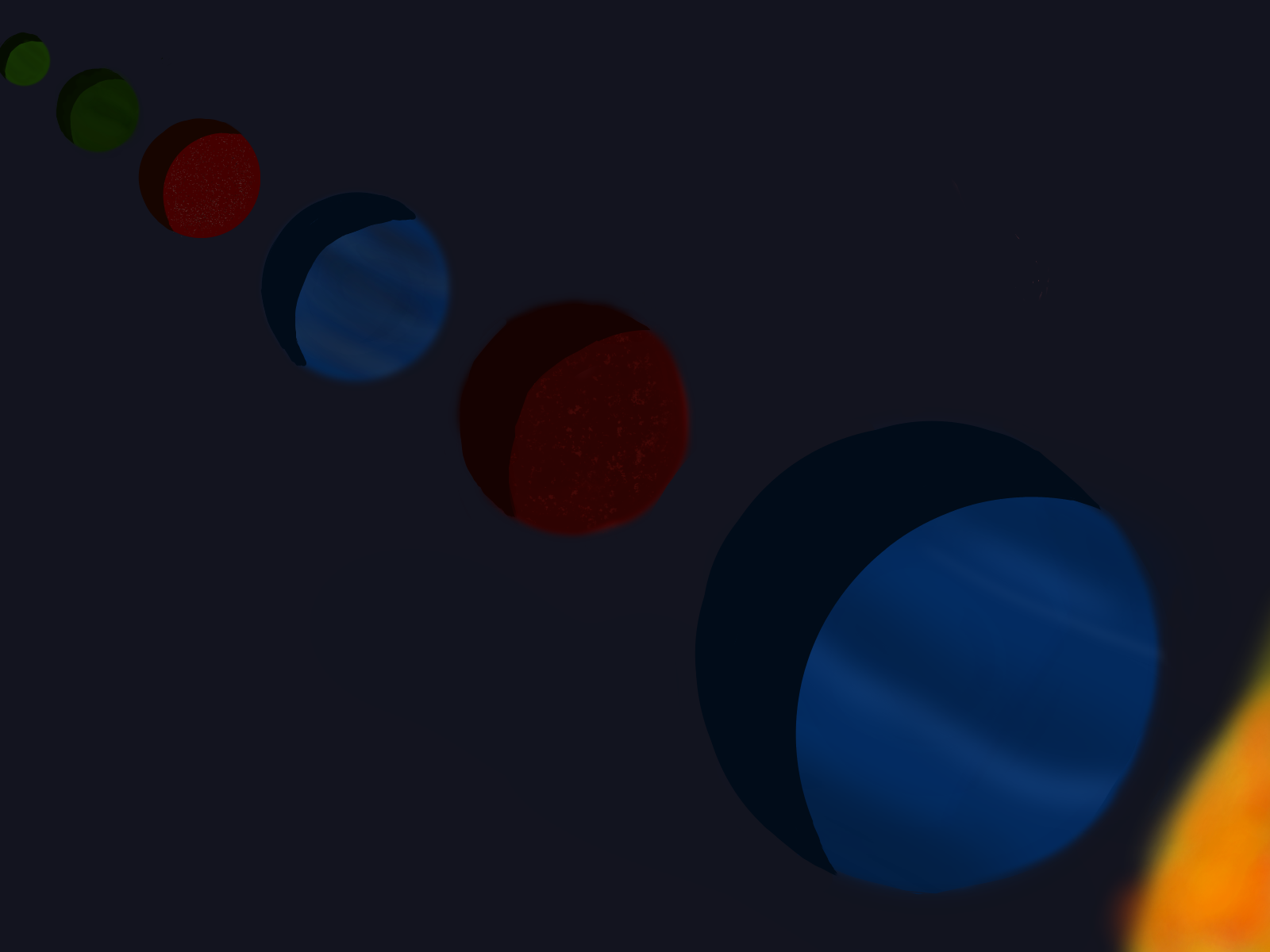
Full View of the Concept Art for the HD110067 Series (Yuna Watanabe)
【References】
The University of Tokyo, “Discovery of Six Resonant Planets—The HD 110067 Planetary System, Where All Adjacent Planets Share a Total Relation in Their Orbital Periods”:
https://www.u-tokyo.ac.jp/focus/ja/press/z0109_00101.html
Wikipedia「HD 110067」:https://ja.wikipedia.org/wiki/HD_110067
Sorae, 「「HD 110067」に共鳴し合う6つの惑星を発見 惑星科学における重要な “化石”」:
https://sorae.info/astronomy/20231210-hd110067.html
Yahoo News, 「6つの惑星が「軌道共鳴」状態にある恒星系、100光年先で新たに発見」:https://news.yahoo.co.jp/articles/60006f29da1de5f15dac66c2d4cf5956624aebf9
(文責:新原)
HD 110067系の詳細な情報はこちら

