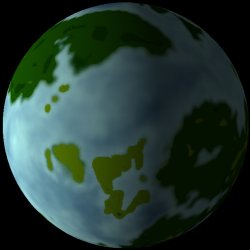
Gliese 12 b is an exoplanet with a radius 0.96 times that of Earth (1.03 times according to Exokyoto) and a mass approximately 1.57 times that of Earth. It orbits the M-type dwarf star Gliese 12 (TOI-6251) at a distance of 0.066 AU with an orbital period of 12.76 days. It was discovered as an exoplanet candidate in 2024 by NASA’s TESS space telescope and confirmed through transit observations using the MuSCAT2 multicolor imaging camera mounted on the 1.52-meter telescope (Carlos Sánchez Telescope) at the Teide Observatory on Tenerife, Spain, and the MuSCAT3 multicolor imaging camera mounted on the 2-meter telescope at the Haleakala Observatory on Maui, Hawaii.
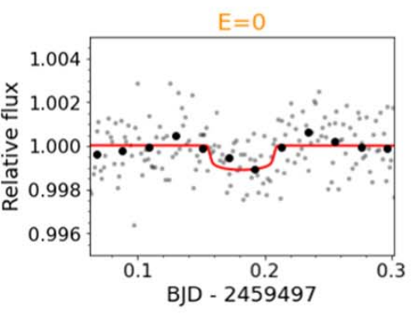
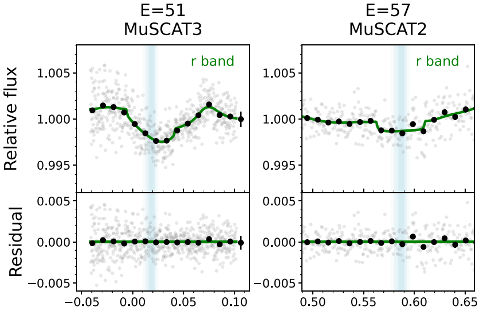
Left: Tess transit analysis; Right: MuSCAT3/MuSCAT2 transit analysis
Credits: https://iopscience.iop.org/article/10.3847/2041-8213/ad3642
The habitable zone of the host star Gliese 12 is believed to extend from an inner boundary of 0.062 AU (the orbital radius receiving radiation equivalent to that of Venus) to an outer boundary of 0.130 AU (the orbital radius receiving radiation equivalent to that of Mars). Gliese 12 b’s orbital radius of 0.07 AU places it within the habitable zone, which is comparable to the solar system and lies close to Venus’s orbit. However, the radiation at the planet’s boundary is 2,281 W/m², which is thought to fall between that of Earth (1,367 W/m²) and Venus (2,612 W/m²). Therefore, it is possible that the planet is in a state similar to that of Venus in its early days, before its oceans dried up.
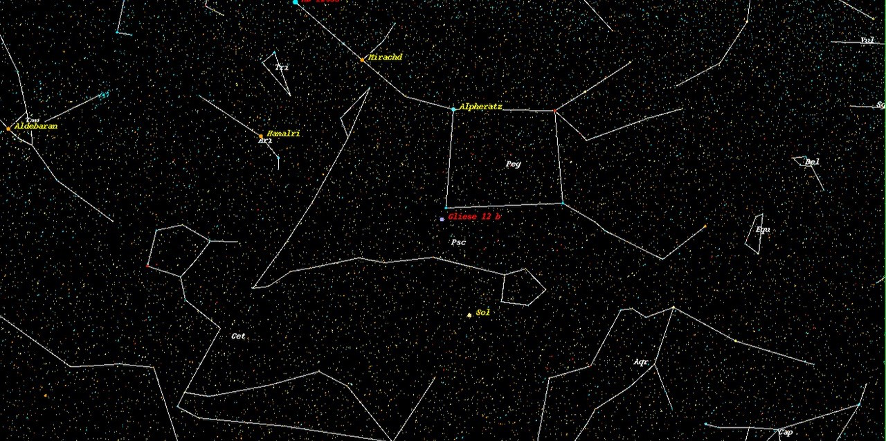
Location of Gliese 12 b
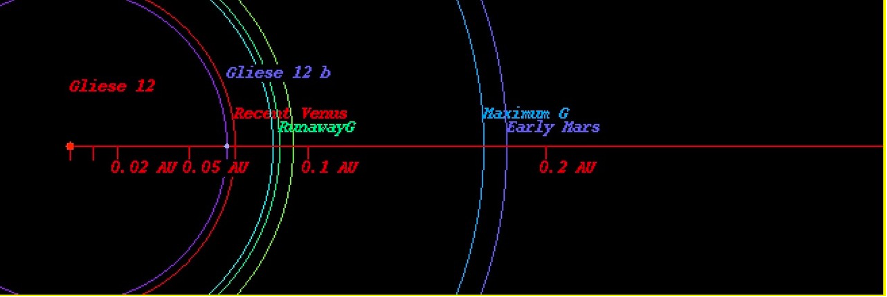
Orbital path of Gliese 12 b
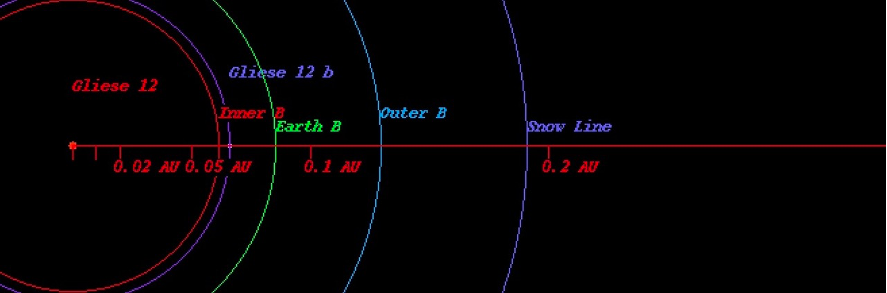
Comparison with our Solar System

Credits: ExoKyoto(https://www.exoplanetkyoto.org/exohtml/Gliese_12_bJP.html)
Furthermore, based on near-infrared observations from the Subaru Telescope—one of the world’s largest telescopes with an 8.2-meter primary mirror located at the Hawaii Observatory—and X-ray observations from ESA’s XMM-Newton X-ray astronomy satellite, the surface temperature of this planet is estimated to be approximately 42°C assuming an albedo of zero, and approximately 15°C assuming an albedo of 0.3; however, if an atmosphere exists and a greenhouse effect is present, the temperature should be even higher. The host star, Gliese 12, exhibits low levels of extreme ultraviolet radiation, indicating low stellar activity. This suggests that frequent flares are unlikely to occur and that the planet’s atmosphere may still be intact. Whether Gliese 12 b has a habitable environment will require awaiting future observations of the planet’s atmospheric composition by the James Webb Space Telescope (JWST).
Stars are classified into seven spectral types—O, B, A, F, G, K, and M—based on the characteristics of their spectra (the Harvard classification), with O having the highest surface temperature and M the lowest. The Sun, the star of our home planet Earth, is a G-type star. It is believed that M-type stars make up the largest proportion of stars in the universe, accounting for approximately 76%, while O-type stars are the least common, in inverse order to surface temperature. Habitable environments around low-temperature M-type host stars are thought to exist where the planet is close to the star and has a short orbital period, as seen with Gliese 12 b. Because of this, such environments are more susceptible to the effects of the host star, such as solar flares. However, when the host star, like Gliese 12, is not highly active (in terms of magnetic fields), the environment is considered habitable, and it is expected that life could exist there. This is a planet for which we look forward to future detailed observations by instruments such as the JWST.
(文責:小塚・山敷)

