CoRoT 3 b

CoRoT 3 b

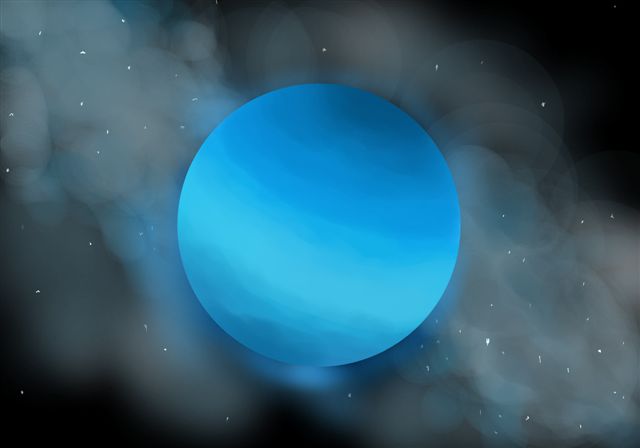
COROT-exo-3b fits into the category of a failed star known as a brown dwarf, but the team that made the discovery has not ruled out the possibility that it is a planet. Brown dwarfs are failed stars. They burn lithium but are not massive enough to generate the thermonuclear fusion of hydrogen and helium that powers real stars. Planets do none of that.

The object has a mass 20 times greater than that of Jupiter but is roughly the same size. It falls outside the range of planets and stars discovered to date, with the largest planets having 12-Jupiter-mass and the smallest stars 70-Jupiter-mass.
If astronomers confirm the object as a planet, it would weigh in as the most massive and densest planet found so far. A full study will be detailed in the journal Astronomy and Astrophysics.

“COROT-exo-3b might turn out to be a rare object found by sheer luck”, said Francois Bouchy, an astronomer at the Institut d’Astrophysique in Paris. “But it might just be a member of a new-found family of very massive planets that encircle stars more massive than our sun. We’re now beginning to think that the more massive the star, the more massive the planet.”

The host star CoRoT 3 has an apparent magnitude of 13.3, with an absolute magnitude of 4.14. It is 1.41 times more massive and 1.44 times bigger compared with our sun. The surface temperature is 6558 K with its spectral type of F3V. In this planetary system, the extrasolar planet CoRoT 3 b orbits around the star CoRoT 3 with its orbital distance of 0.0570.

Paper:

https://www.aanda.org/10.1051/0004-6361:200810625


Journal Articles:

1.) The Rossiter-McLaughlin effect of CoRoT-3b and HD 189733b

2.) Transiting exoplanets from the CoRoT space mission, VI. CoRoT-Exo-3b: the first secure inhabitant of the brown-dwarf desert

3.) CoRoT’s first seven planets: An overview

WEB Articles:
1.) Huge Planet Defies Explanation

2.) 系外惑星の分類に疑問投げかける天体を発見

Floating Planets

(Image credit: Rina Maeda, SGH Moriyama high school)

Floating Planets (or Rogue Planets) are planetary masses that are not gravitationally connected to stars, brown dwarfs, or other celestial bodies, and orbit directly around a galaxy. They can be repelled out by various mechanisms, such as an orbital shift of gas giants, or by massive objects passing nearby. However,  there are also floating planets that were formed by the gravitational collapse of a gas cloud, but they were too small to undergo a fusion reaction at their centers, which is the case with normal stars. The term planetary-mass object (PMO) is used to refer to all of these planetary and quasi-planetary objects. There is no radiative heat source from a host star, but in the case of rocky planets, there is the possibility of an internal heat source (radioactive decay), and in the case of gas giants, it is thought that infrared radiation from compression may be trapped and retain heat and thus the planet can maintain an atmosphere. The number of these gas giants is thought to be twice as much as the number of stars in our galaxy, and only in February 2017 did observations of galaxies outside the system, using the microlensing method, capture enough evidence for the existence of this large number of floating planets in galaxies outside our system.
(Yamashiki and Sasaki)

CoRoT-7b

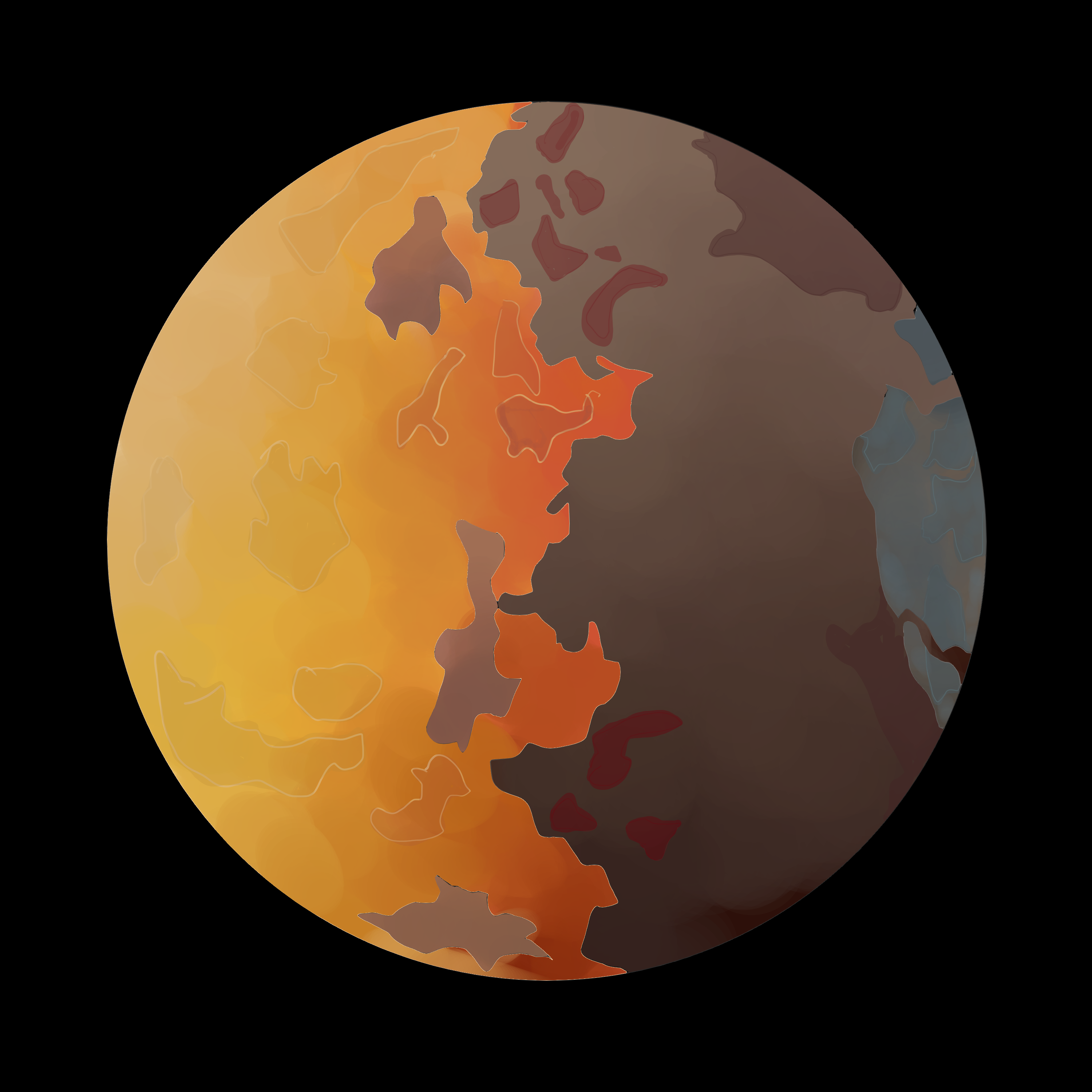
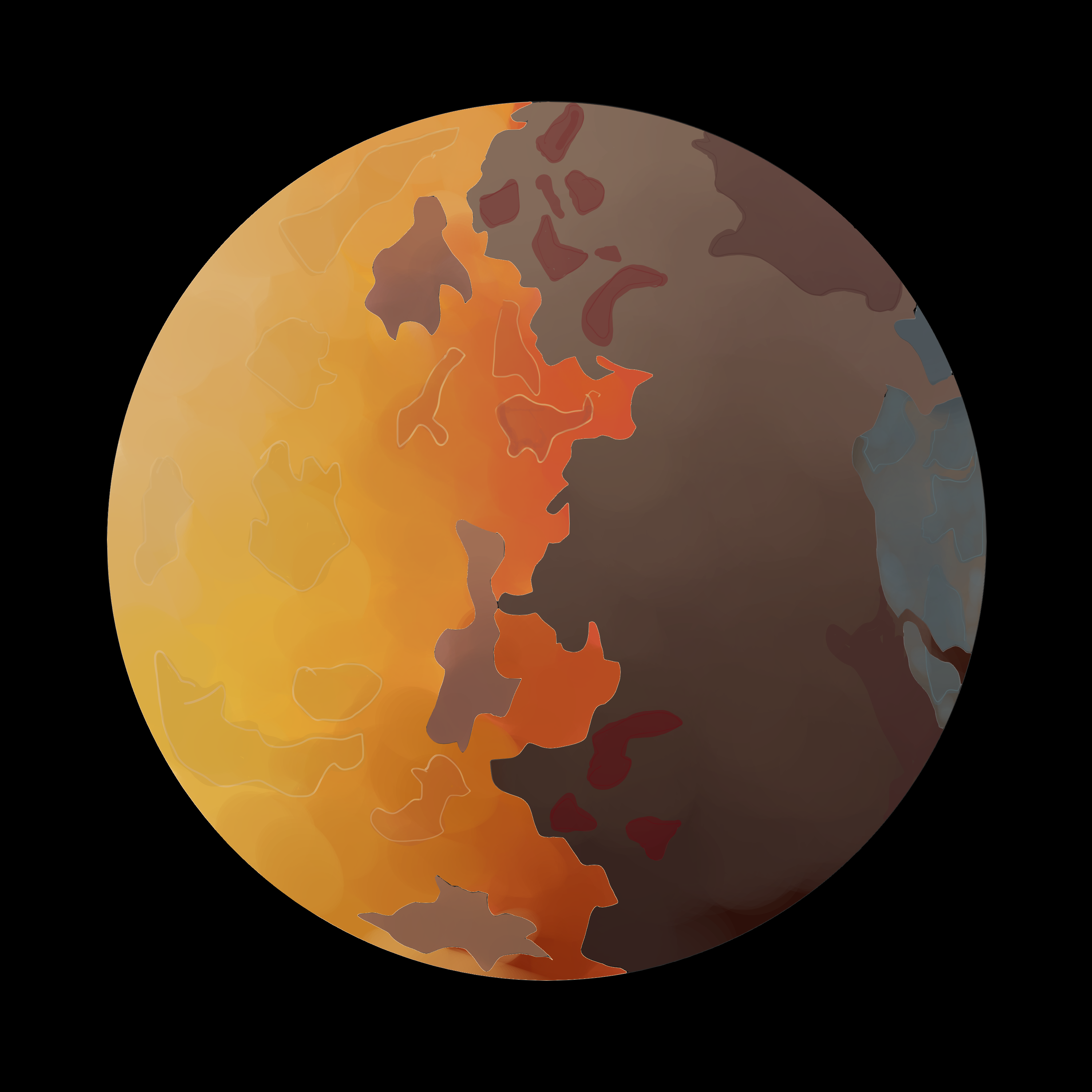
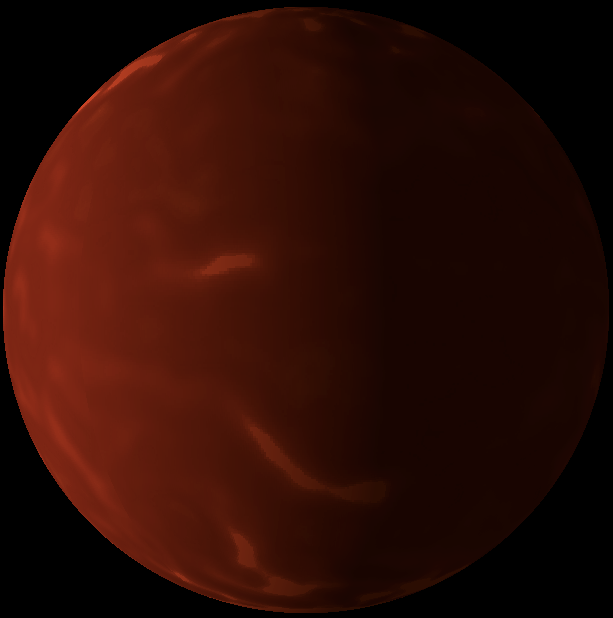
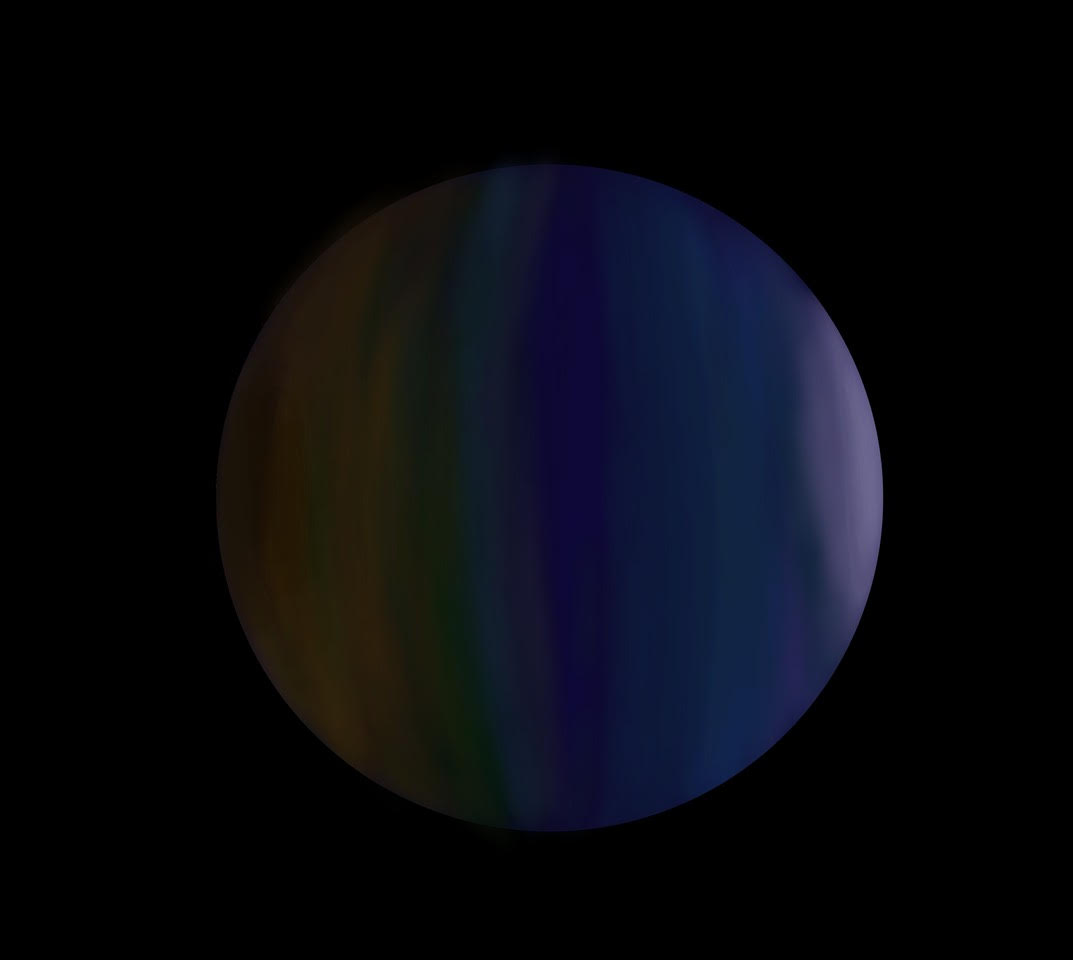
(Imaginary Image of CoRoT-7b by Rina Maeda from Moriyama SGH) A tidally locked planet with a surface temperature of over 2000 degrees on the day-side, and ice on the night-side.


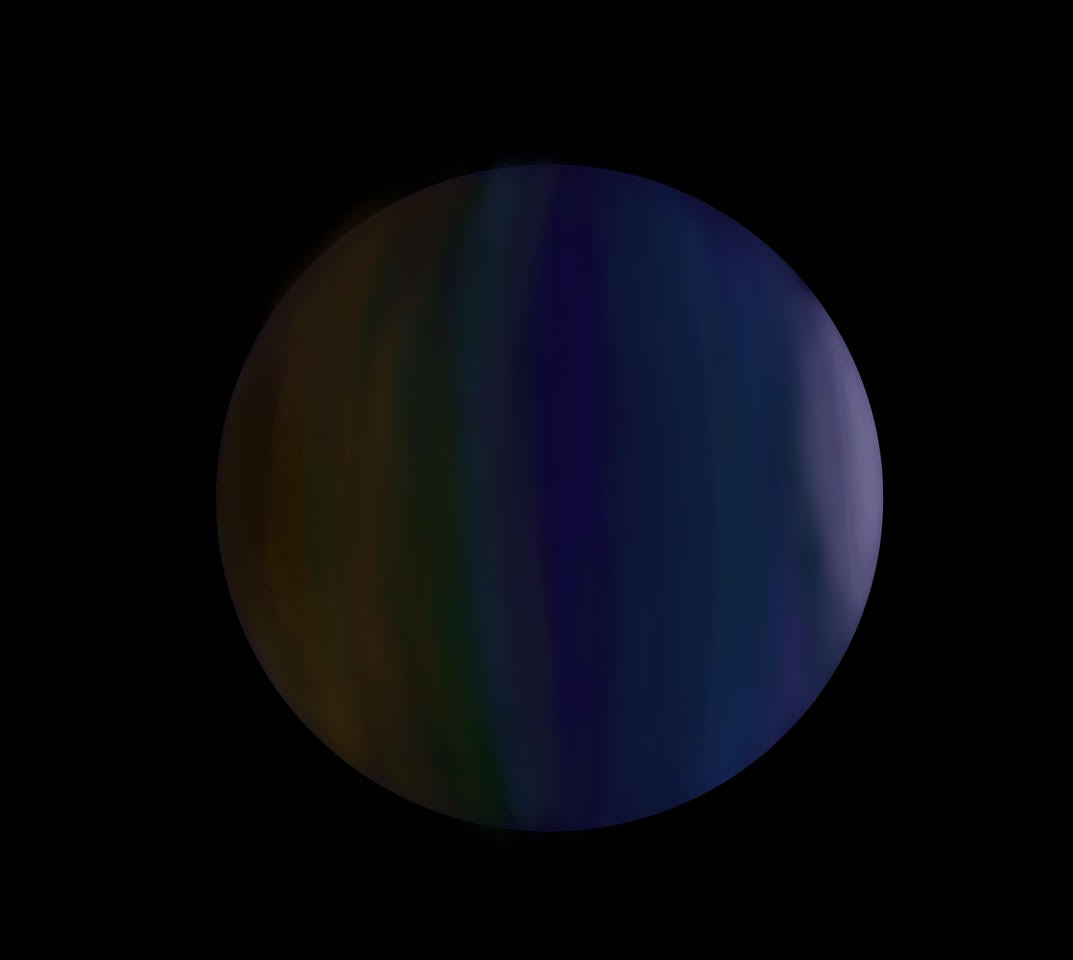
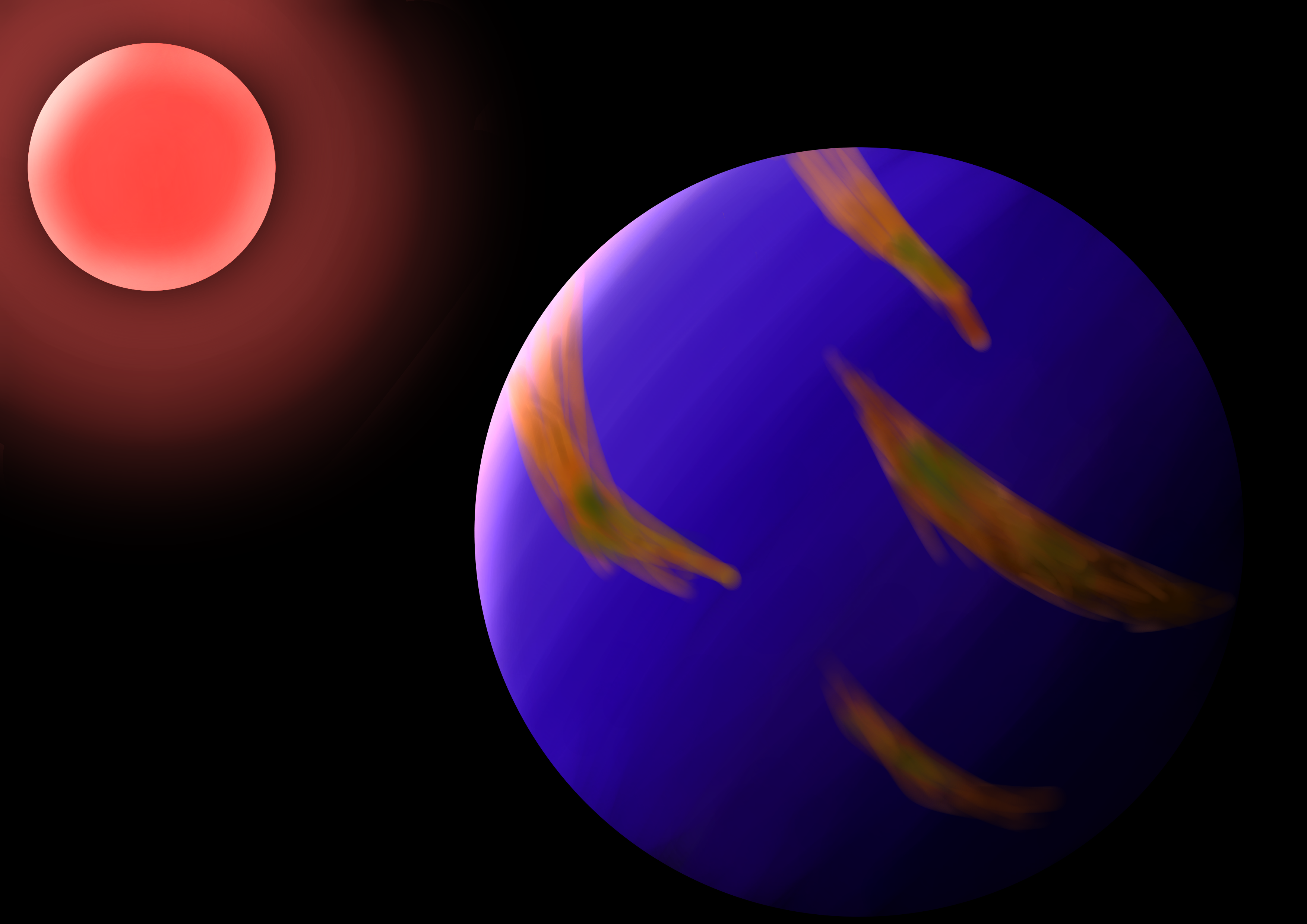
(Imaginary Image of CoRoT-7b Credit: Ryusuke Kuroki, Yosuke Yamashiki )

CoRoT-7b is an exoplanet discovered by the COROT space telescope mission, using the transit method in February 2009. The planet is located in the center of the constellation Monoceros, 489 light years away from our solar system. It has a very small radius at 1.52 times that of the Earth, which was the smallest exoplanet when it was discovered. It has an extremely short orbit of only 0.85 days (about 20 hours) and orbits very close to its host star at a distance of 2.57 million km (0.02 AU, less than 1/20th of the distance between the Sun and Mercury).
Due to its density, CoRoT-7b is classified as a Super Earth, but it has also been considered as a Super Io.
Io, one of Jupiter’s moons, is volcanically active, with an interior temperature that rises due to tidal heating, which is caused by Jupiter’s gravity. CoRoT-7b is thought to be the same, experiencing tidal heating due to the influence of its hoststar CoRoT-7 along with another orbiting planet CoRoT-7c.
CoRoT-7b is tidally locked, due to its short orbital length radius, and because one surface is always facing the host star, that side of the planet can reach over 2000 degrees Celsius, while the opposite side can reach -200 degrees Celsius. ExoKyoto estimates the temperature on the day-side to be about 2110 K (assuming an albedo of 0.1) or 1982 K (assuming an albedo of 0.3).
CoRoT-7b is thought to be a rocky planet like Earth, but it is unlikely to support life due to its severe temperatures. Land on the star side would be covered with molten lava, and there is a possibility of active volcanic activity on the other side.

(執筆 佐藤啓明 修正担当 山敷庸亮)
Victoria Jaggard (2010)「最も地球に似た系外惑星はスーパーイオ」(Reference 2018-1-19)

“AstroArts”  (2009) 「最小の系外惑星を発見」(参照2018-1-19)

“AstroArts” (2009)「最小系外惑星は、地球に似た岩石惑星か」(参照2018-1-19)

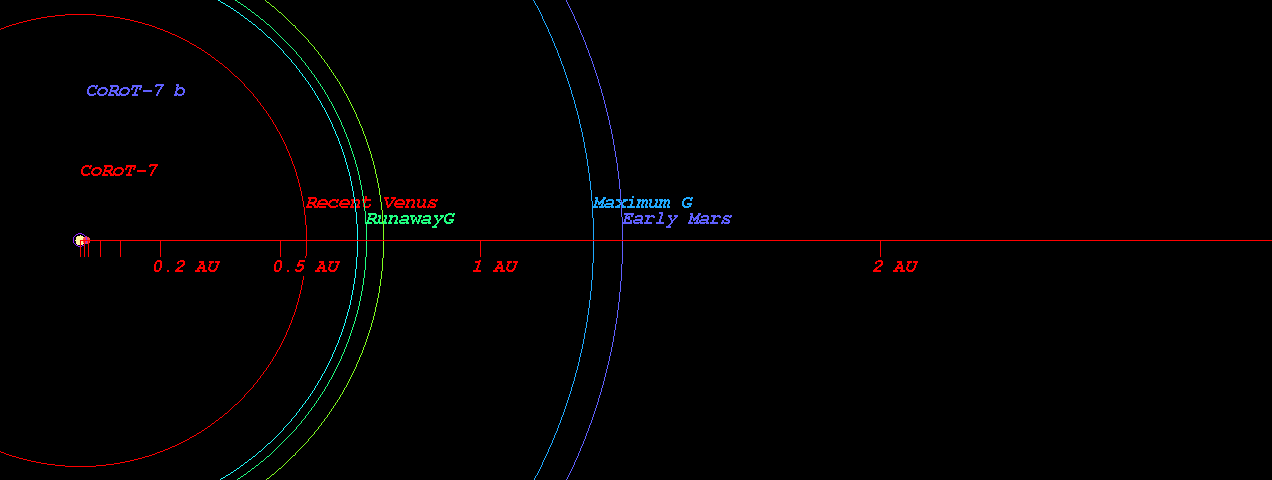
CoRoT-7’s Habitable Zone

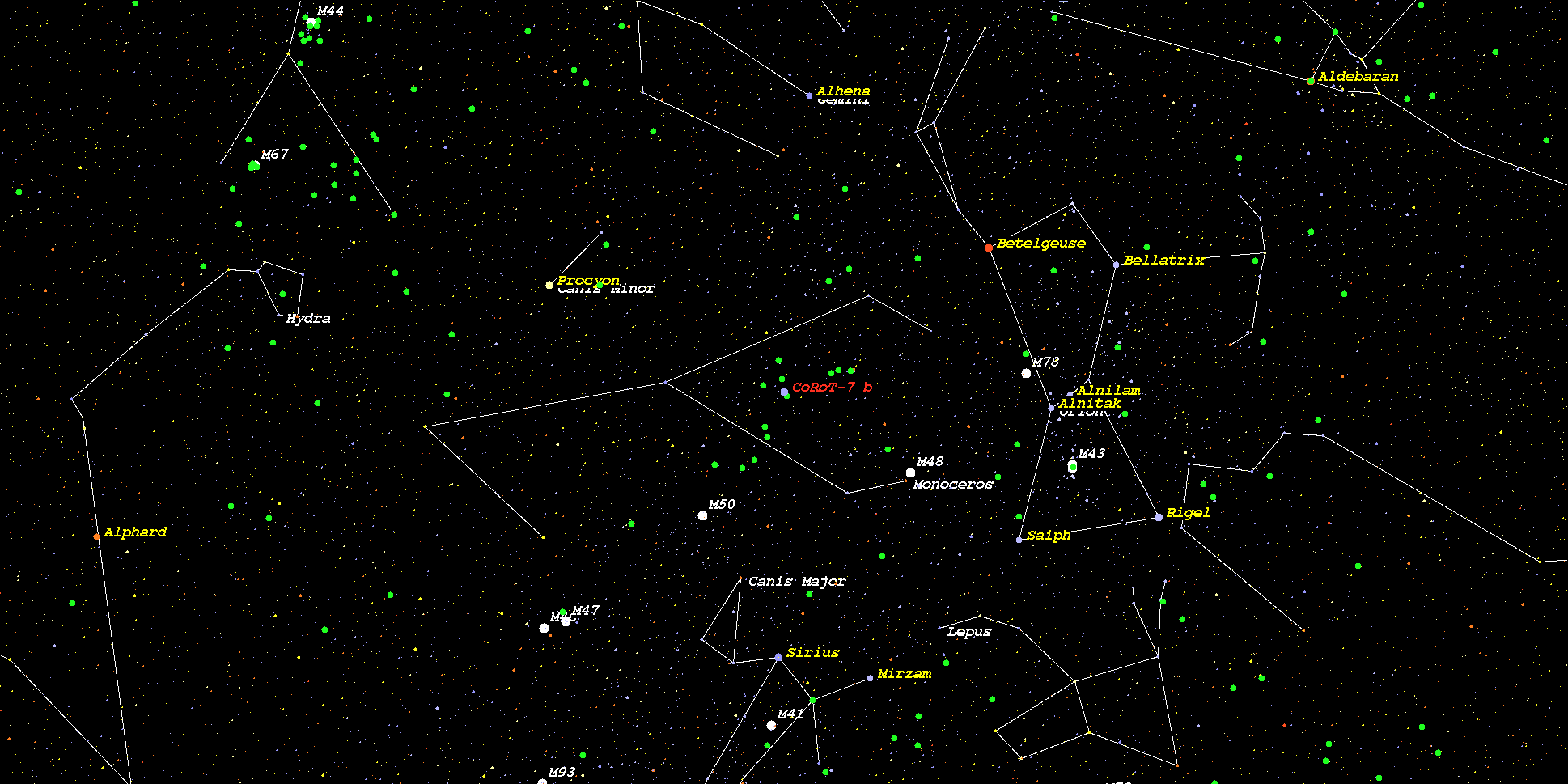
CoRoT-7’s Location on the Stellar Map

For more information on CoRoT-7b, please see the following:
http://www.exoplanetkyoto.org/exohtml/CoRoT-7_bJP.html

GJ667Cc

(Image of a tidally locked planet like GJ667Cc Credit: Natsuki Shirako, SGH Moriyama High School)


(Imaginary Image of GJ667Cc Credit: Miu Shimizu  (SGH Moriyama High School) )

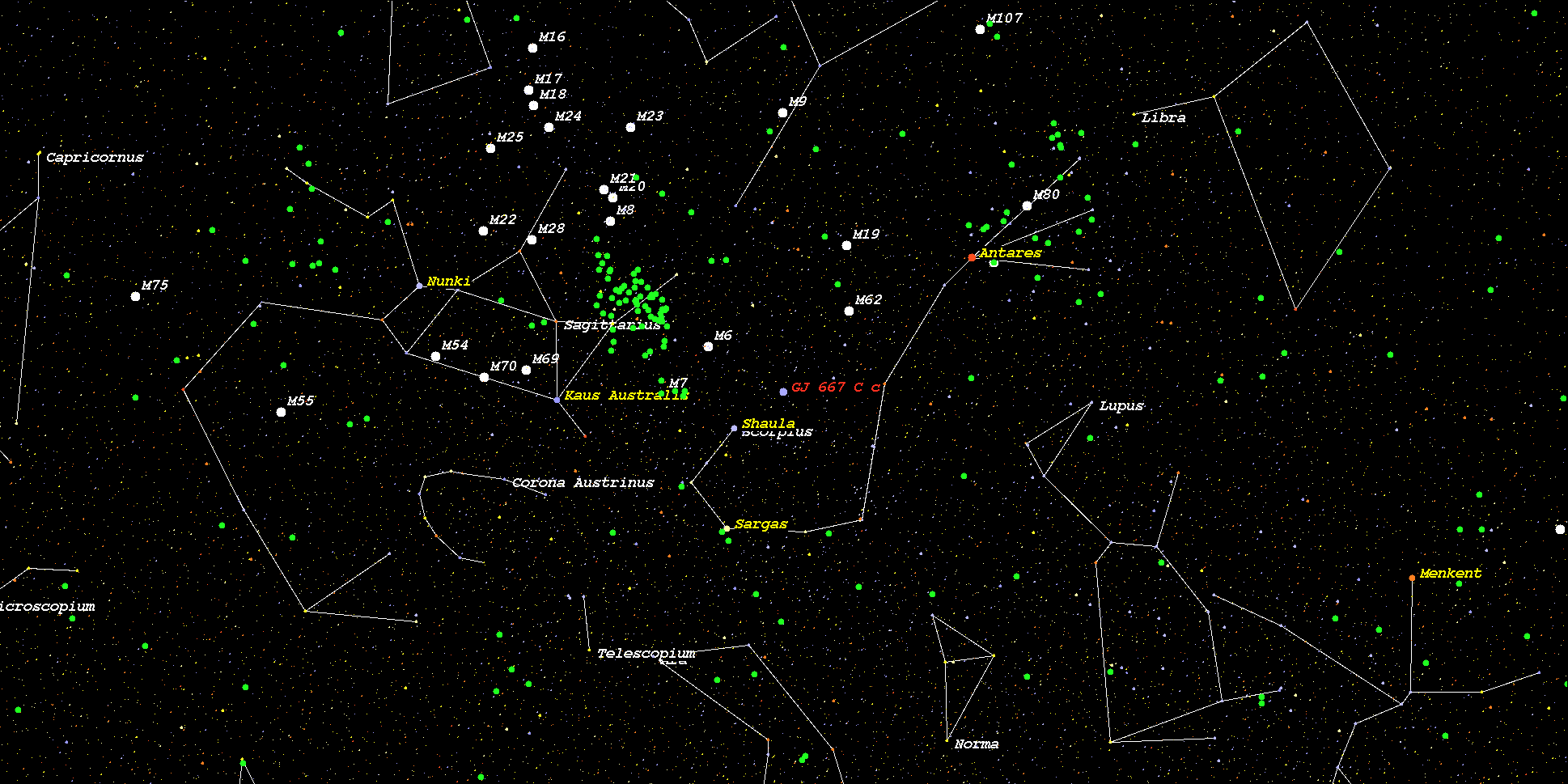
The planet, dubbed GJ 667Cc, orbits a red dwarf star 22 light-years from Earth, in the constellation Scorpio. A binary pair of orange dwarf stars are part of the same system.

The new planet has a mass 4.5 times that of Earth and orbits its host star every 28 days.

The red dwarf is relatively dim, so the planet receives slightly less light from its star than Earth does from the sun. But most of the star’s light is infrared, so the planet should absorb more of its incoming energy than Earth does from sunlight.

That means if the planet has a rocky surface—which is predicted for planets less than ten times Earth’s mass—and an atmosphere, it could support liquid water and maybe life said co-discoverer Guillem Anglada-Escudé, who conducted the work while at the Carnegie Institution for Science in Washington, D.C.

“If it has an atmosphere, it’s probably reddish all the time, because the star is really red,” Anglada-Escudé said. “It would be like being evening all the time.”

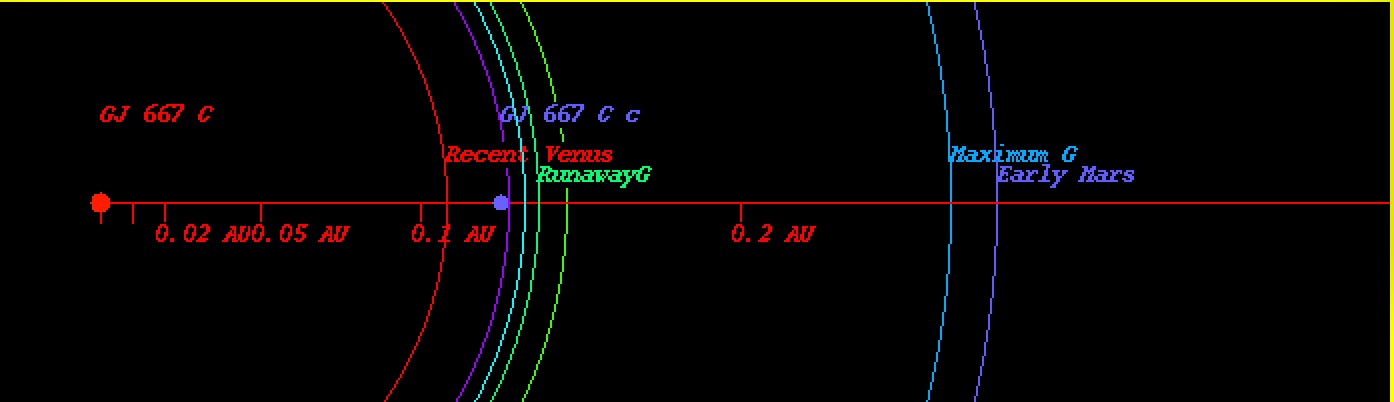
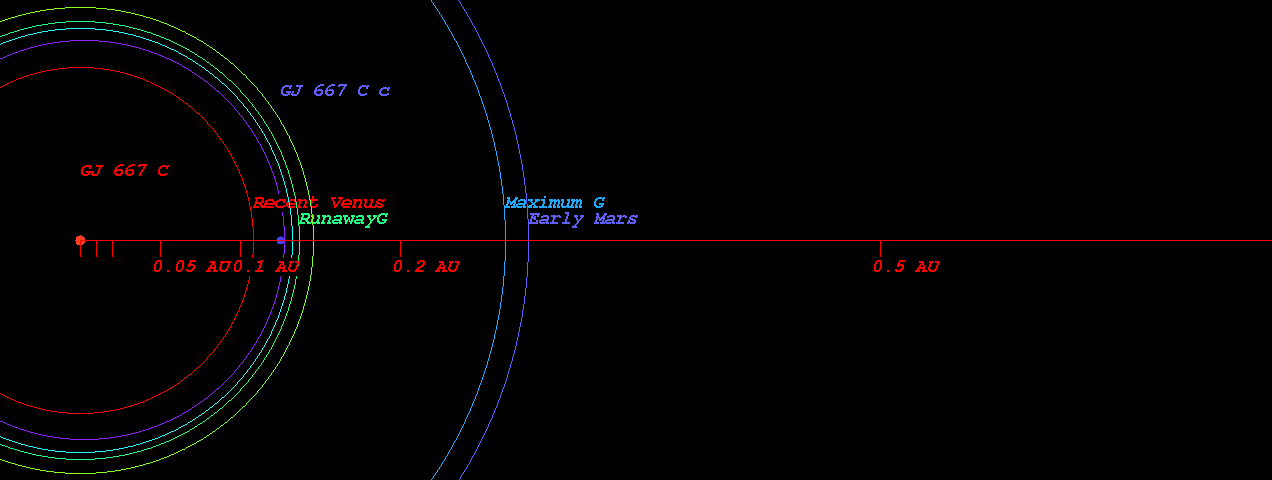
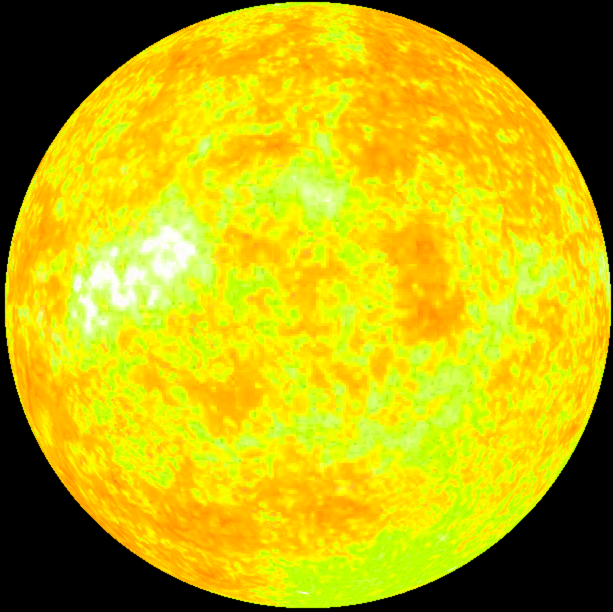
The host star GJ 667 C has an apparent magnitude of 10.2, with an absolute magnitude of 11.04. It is 0.33 times more massive and 0.34 times bigger compared with our sun. The surface temperature is 3600 K with it’ spectral type of M1.5v. In this planetary system, the extrasolar planet GJ 667 Cc orbits around the star GJ 667 C with its orbital distance of 0.125.

(梨元昴・山敷庸亮)

Reference

http://www.eso.org/public/archives/releases/sciencepapers/eso1328/eso1328a.pdf


GJ667Cc’s Habitable Zone (Kopparapu et al. 2013)


Location of GJ667C on the Stellar Map

For more information about GJ667Cc, please visit the ExoKyoto Database:
http://www.exoplanetkyoto.org/exohtml/GJ_667_C_cJP.html

Kepler-90 i (Kepler 90 System)


Kepler-90 is a G-type main-sequence star located in the Lyra constellation, about 2545 light years from Earth.
It has a mass and volume are about 1.13 and 1.2 times that of our sun. Our sun has a surface temperature of about 5778 Kelvin and it is around 4.6 billion years old, while Kepler-90 has a surface temperature of about 5930 Kelvin and is an estimated 2 billion years old.

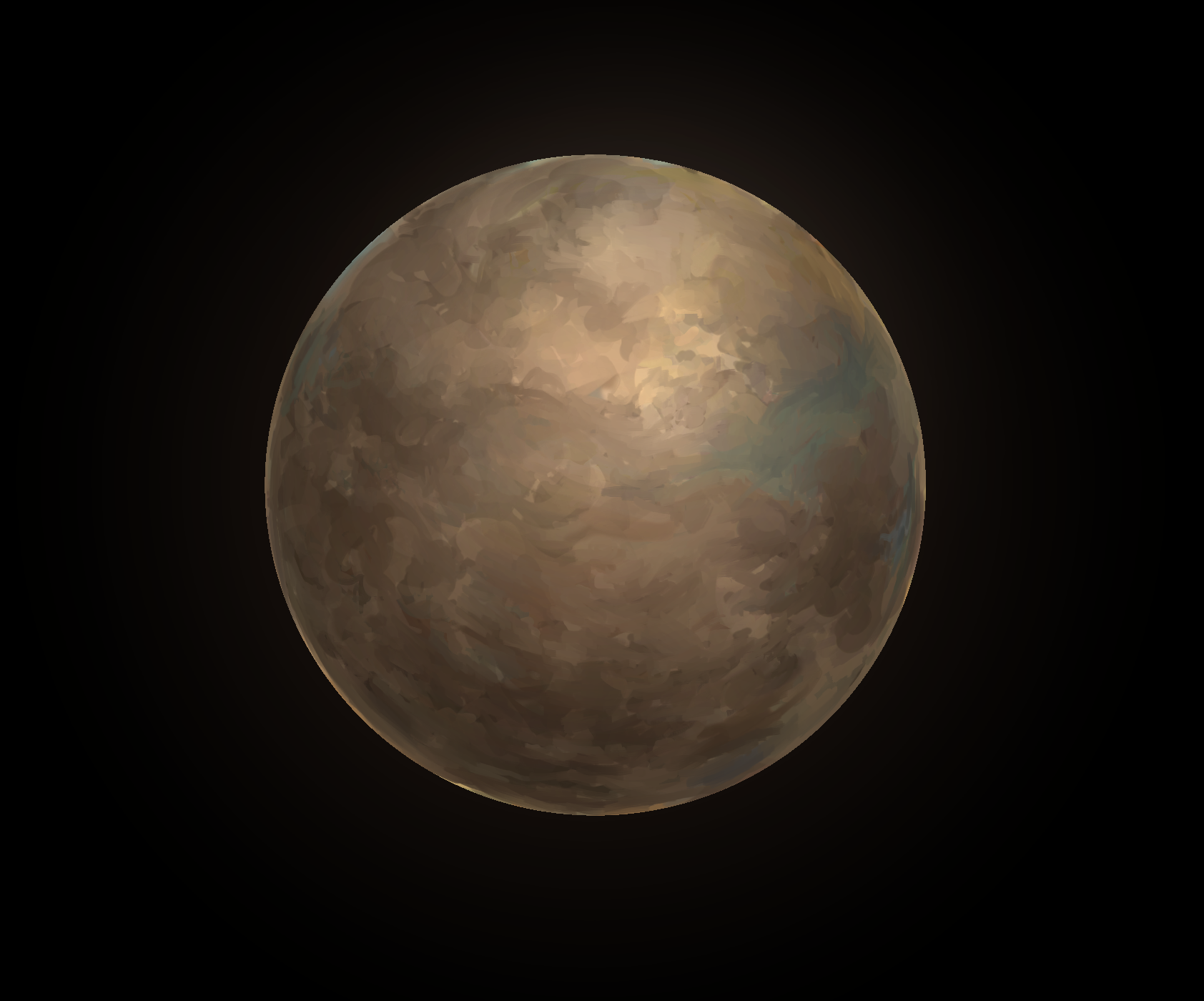
<Fig. 1 Imaginary Image of Kepler-90: Image credit Fuka Takagi & Yosuke A. Yamashiki>

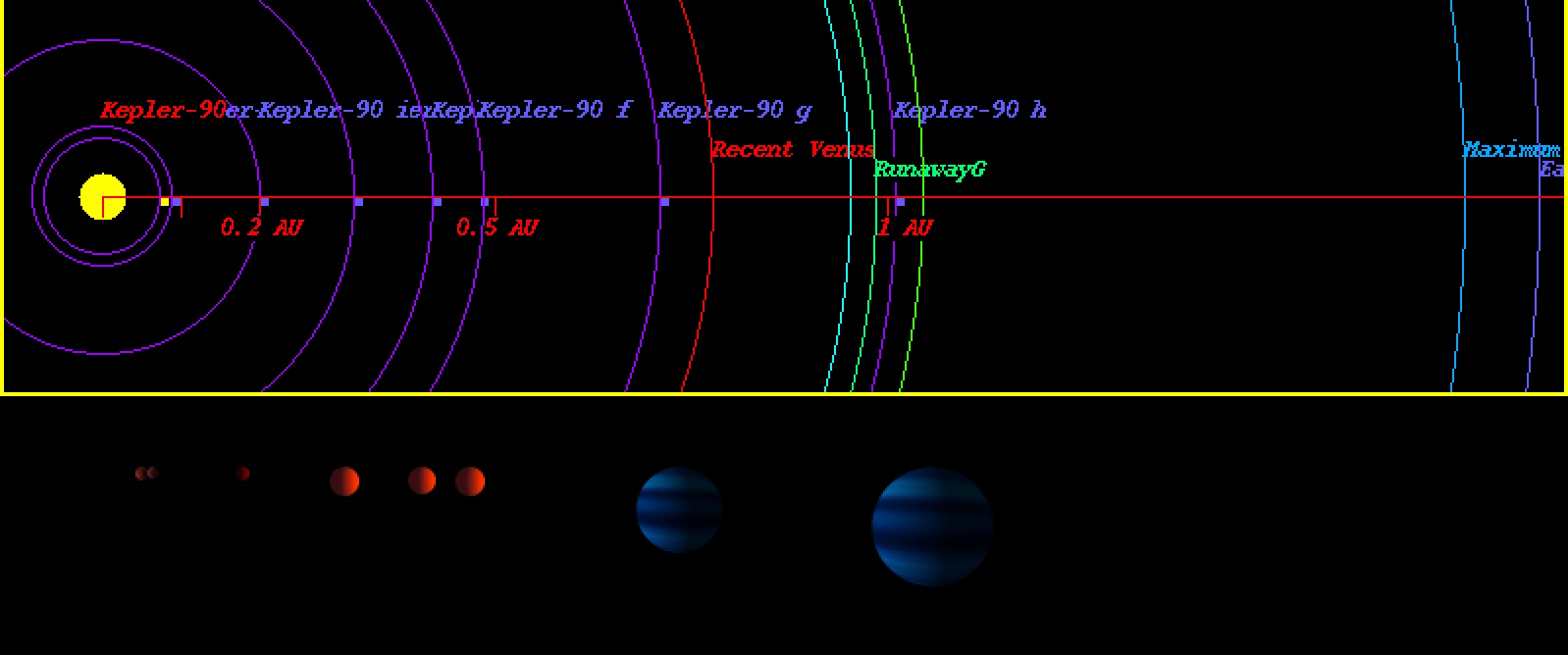
A remarkable discovery found that Kepler-90 also has eight planets in its solar system, the same as our own. This makes Kepler-90 hold the record for most planets orbiting a star that we have discovered yet.

<Fig. 2 Planets Orbiting Kepler-90, Using the ExoKyoto Application>

NASA and Google announced n November 14, 2017, that they discovered Kepler-90i, the eighth planet in the Kepler-90 system. Kepler-90i was discovered by analyzing data from the Kepler Space Telescope using a new machine learning system developed by Google. NASA also discovered Kepler-80g using the same system.

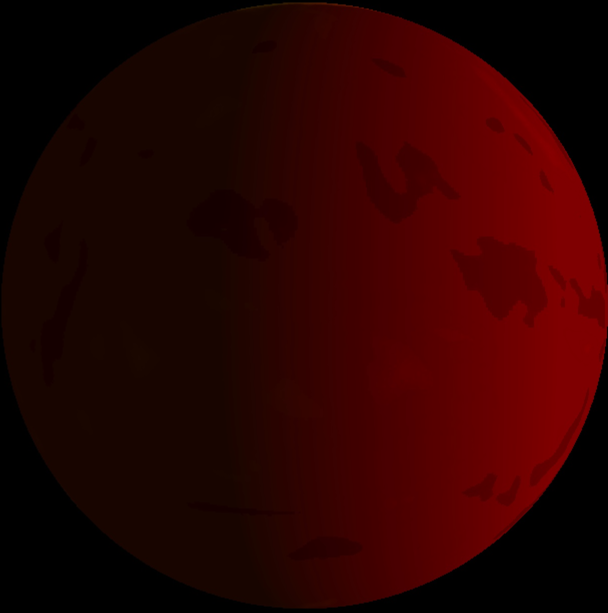
<Fig. 3 Imaginary Image of Kepler-90i Image Credit Ryusuke Kuroki, Yosuke A. Yamashiki>

Kepler-90’s planetary system structure is similar to that of our own solar system. All of the six inner planets are rocky planets, slightly larger than Earth or smaller than Neptune, and the two outer planets are large gas giants. The outermost planet, Kepler-90h, is a Jupiter-sized planet that orbits the host star at the same distance (1.01 AU) as the Earth to the Sun, orbiting the star in about 331 days.

Of course, there are slight differences from our solar system. The outermost planet has an orbital radius roughly equal to that of Earth, and all eight planets are squeezed into a much smaller area than the planets in our solar system. The orbits of the six inner planets are particularly small, for instance, while Mercury has an orbital period of 88 days, Kepler-90i orbits Kepler-90 in just 14.4 days. Consequently, the surface temperature of Kepler-90i can reach 640 Kelvin, and life on the surface is thought to be impossible.

Kepler90Movie

<Movie 1 Kepler-90 and its Planetary Orbits>

It is widely thought that the planets in the Kepler-90 system were once spread out, but for some reason have now moved closer to the host star in their current orbit.

AI produced by Google discovered the new planet by using a neural network of mathematical models, similar to how the human brain works, which identifies a planet’s signal with incredible accuracy. The AI already discovered two exoplanets after analyzing only 670 of the approximately 200,000 celestial objects observed by the Kepler Space Telescope. More exoplanets are expected to be discovered by this method in the near future.

<村嶋慶哉・山敷庸亮>

For more information on Kepler-90i, please visit the ExoKyoto Database:

http://www.exoplanetkyoto.org/exohtml/Kepler-90_iJP.html

 For more information about the host star Kepler-90, please visit the ExoKyoto Database:

http://www.exoplanetkyoto.org/exohtml/Kepler-90JP.html

Ross 128 b (Proxima Virginis b)


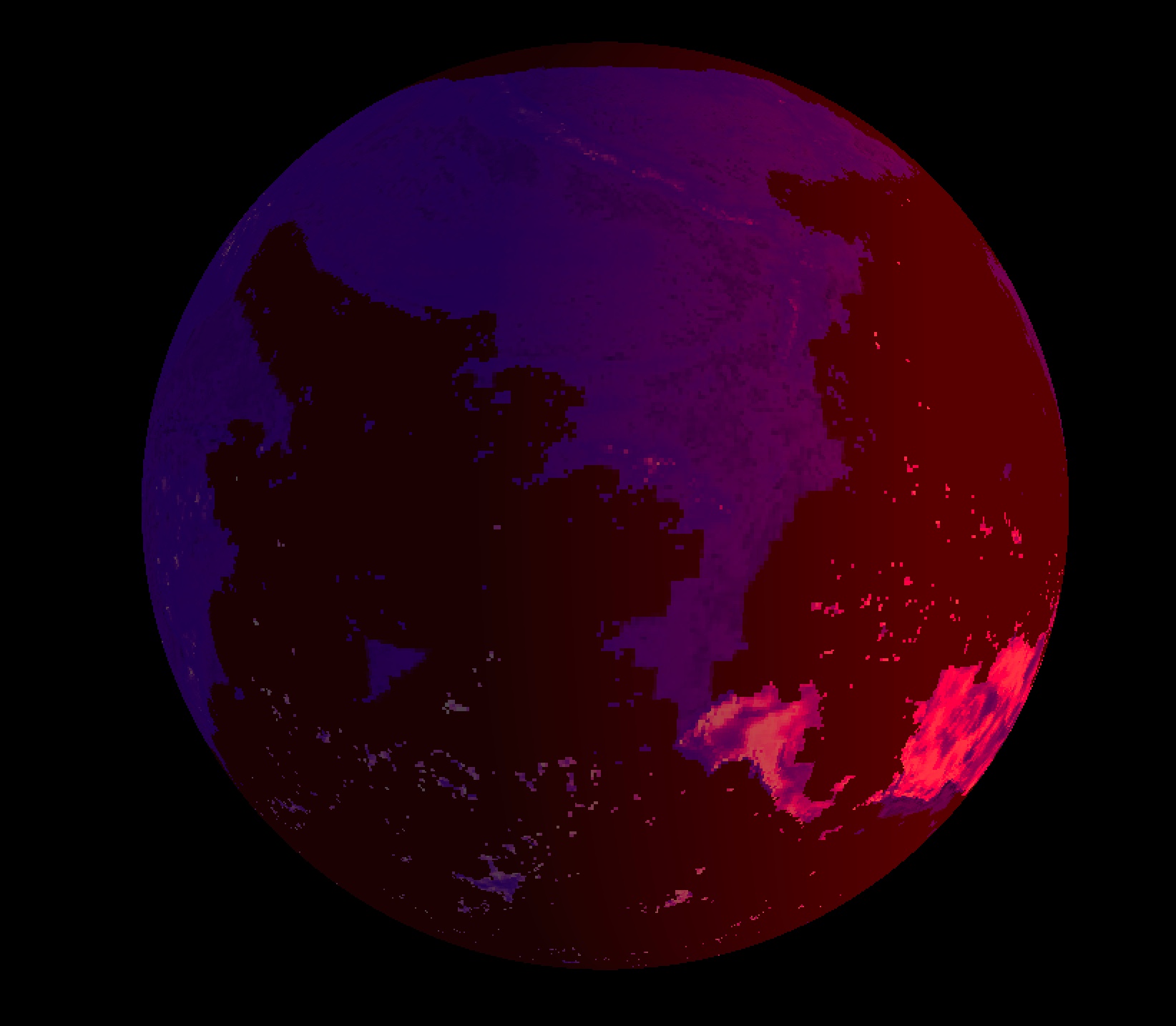
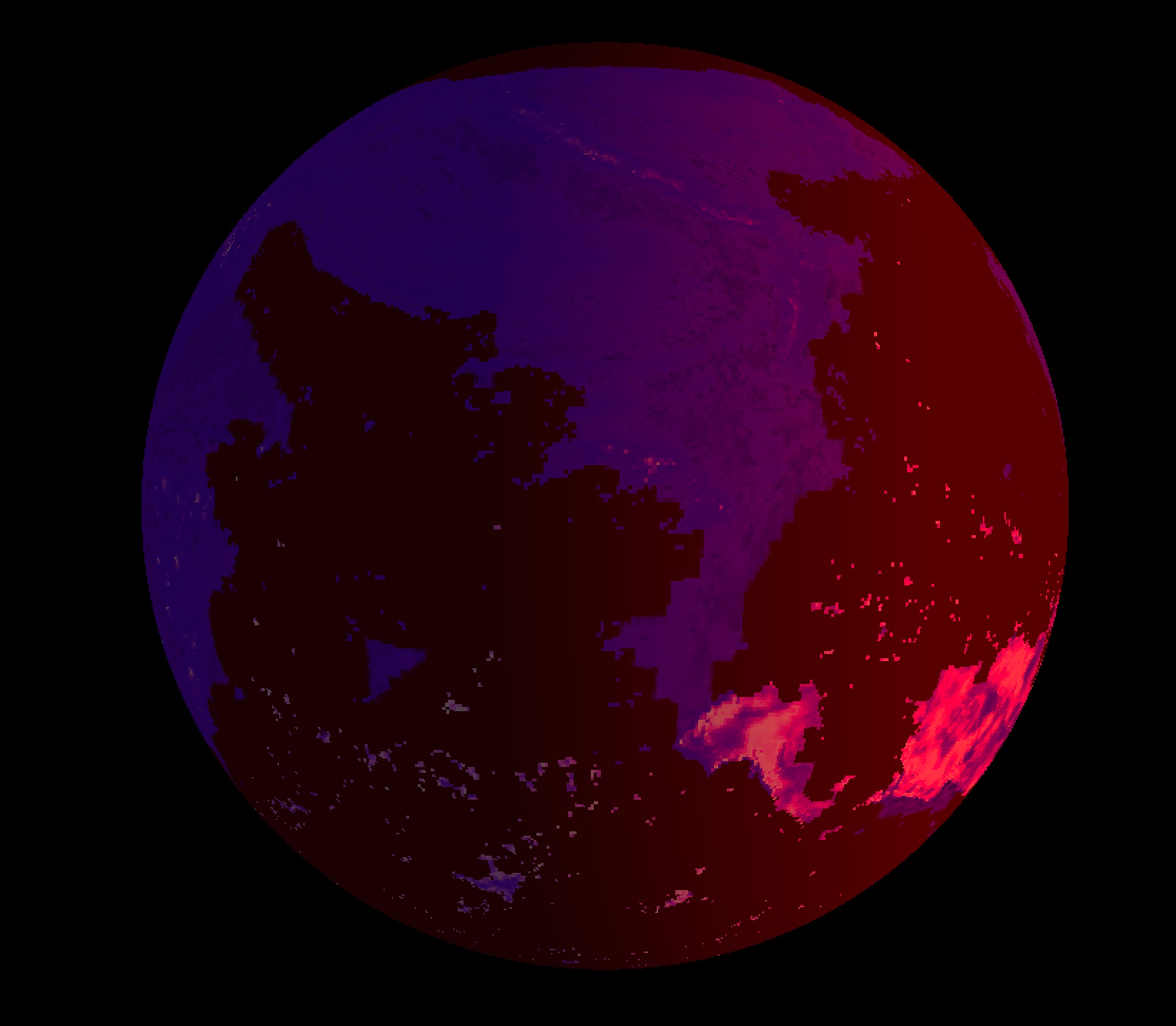
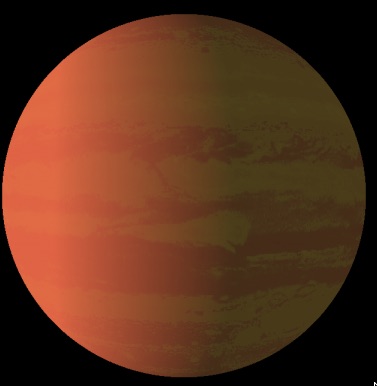
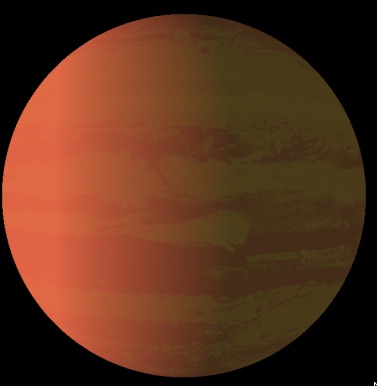
(Imaginary Image of Ross-128b Image Credit 清水海羽 守山高校ハビタブル研究会)

(Imaginary Image of Ross-128b Image Credit: Yosuke Yamashiki, Ryusuke Kuroki)

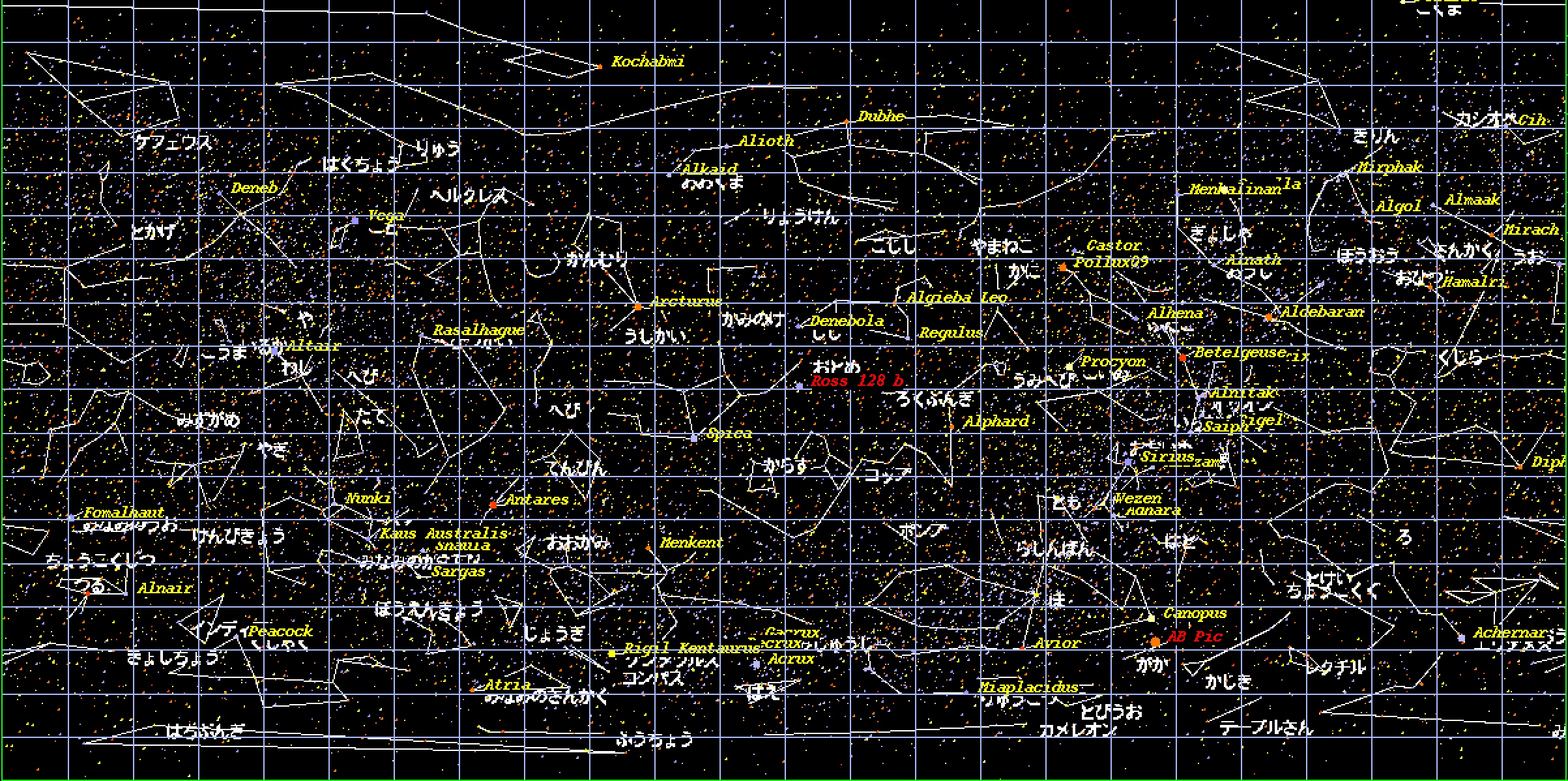
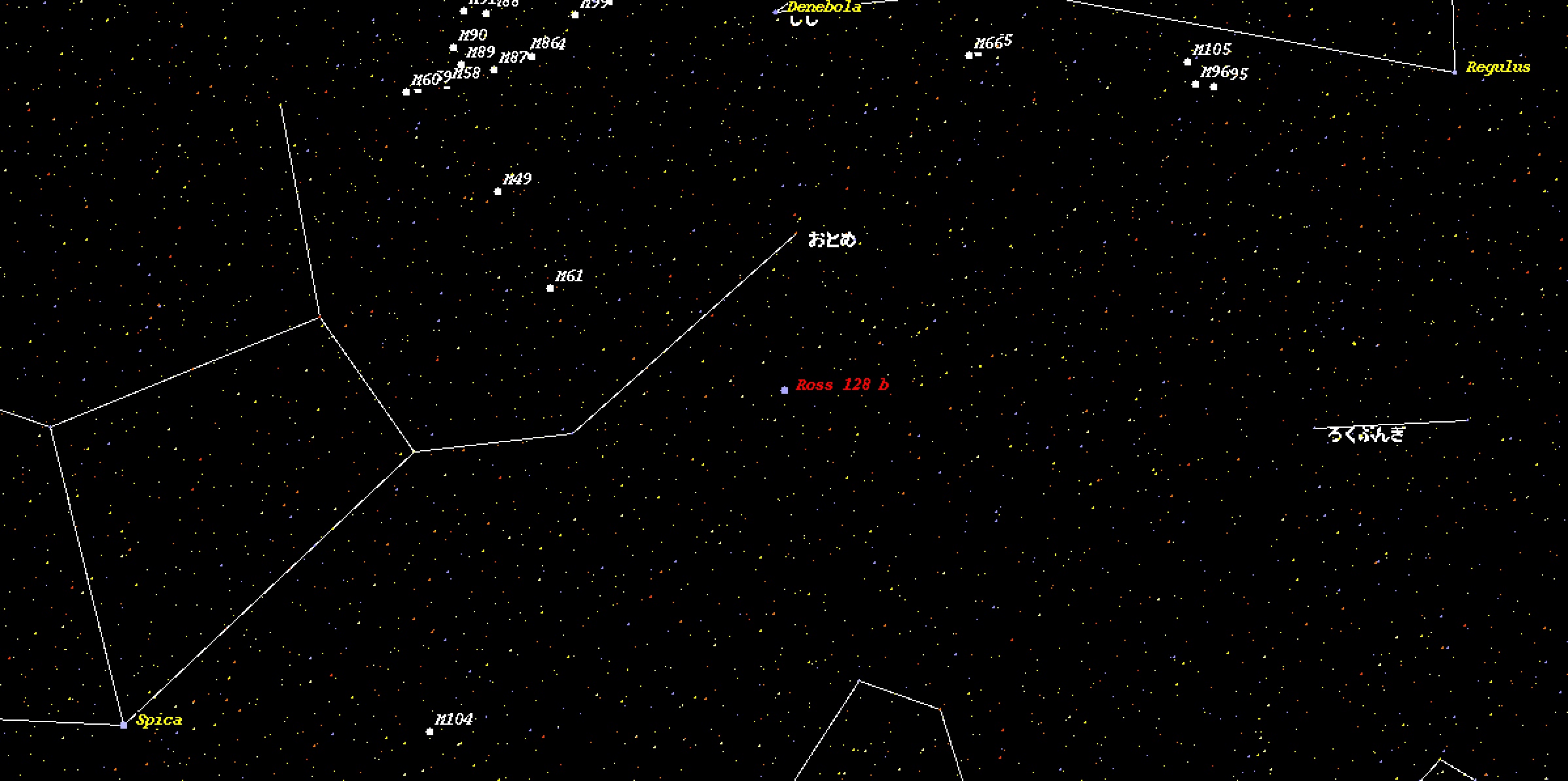
Ross-128b is a new habitable planet has been discovered, located about 11 light years (3.4 parsecs) away from our solar system. Its mass is about 1.35 times that of the Earth (ExoKyoto estimates 1.31), but the exact radius is not known because of a lack of transit. However, according to the mass estimation module (Weiss & Marcy, 2014) by ExoKyoto, the radius is estimated to be 1.078 times that of the Earth. The planet’s host star is Mare Virgo, which is a small M-type star in the constellation Virgo, with an estimated temperature of 3192 K and a mass 0.16 times that of our sun. It is the second closest habitable planet to Earth after Proxima Cen b. A research team from Université Grenoble Alpes in France made the discovery using a 3.6-meter diameter telescope at the European Southern Observatory (ESC) in Chile and the exoplanet survey instrument HARPS*. Ross-128b orbits the star Ross 128 in around 9.9 days per orbit and blackbody temperatures of the planet are 269 K for an Earth albedo (281 K for ExoKyoto) and 213 K for a Venus albedo according to Bonfils et al. 2017, which is classified as habitable (Earth’s blackbody temperature is 255 K).
The star Ross 128, is a red dwarf with a rotation estimated to be more than 120 days, which means that there is only moderate activity and it is unlikely to produce frequent superflares. Becaus eof this, depending on the state of the atmosphere of the planet, liquid water may exist and there is a possiblity it could support life.

A massive telescope scheduled for completion in 2024 called the ELT will begins its observations soon, and it this should be able to study the composition of the planet’s atmosphere to tell us more.

(坂東日菜・山敷庸亮)

For more information abour Ross-128b, please visit the ExoKyoto Database:
http://www.exoplanetkyoto.org/exohtml/Ross_128_bJP.html

X. Bonfils et al. 2017. A temperate exo-Earth around a quiet M dwarf at 3.4 parsecs. Astronomy & Astrophysics manuscript © ESO

Imaginary Image of Ross 128 b (Proxima Vir b) *With no tidal locking.

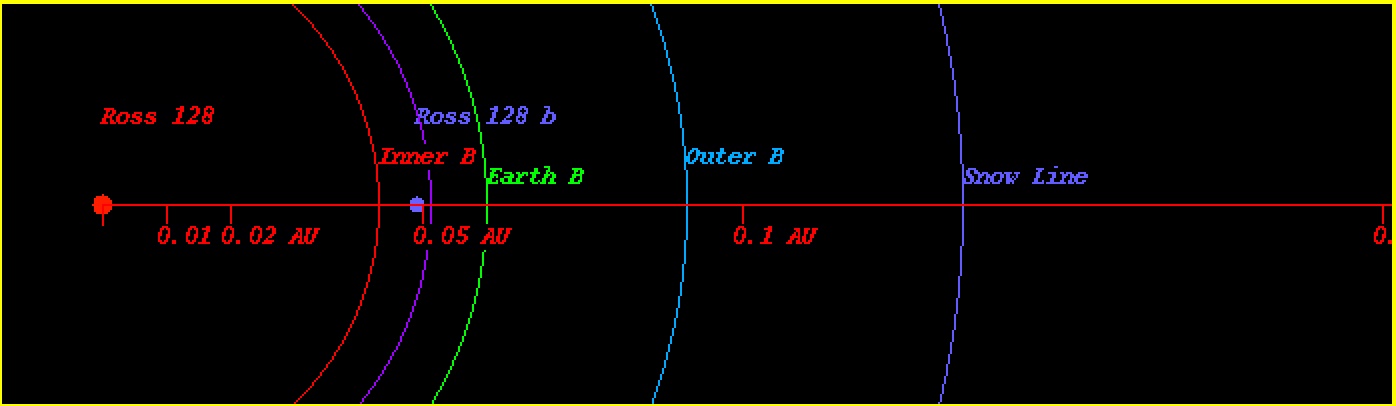
The Habitable Zone of Ross 128 b (Proxima Vir b)

The Habitable Zone Orbits of Ross 128 b (Proxima Vir b) (Kopparapu et al.)
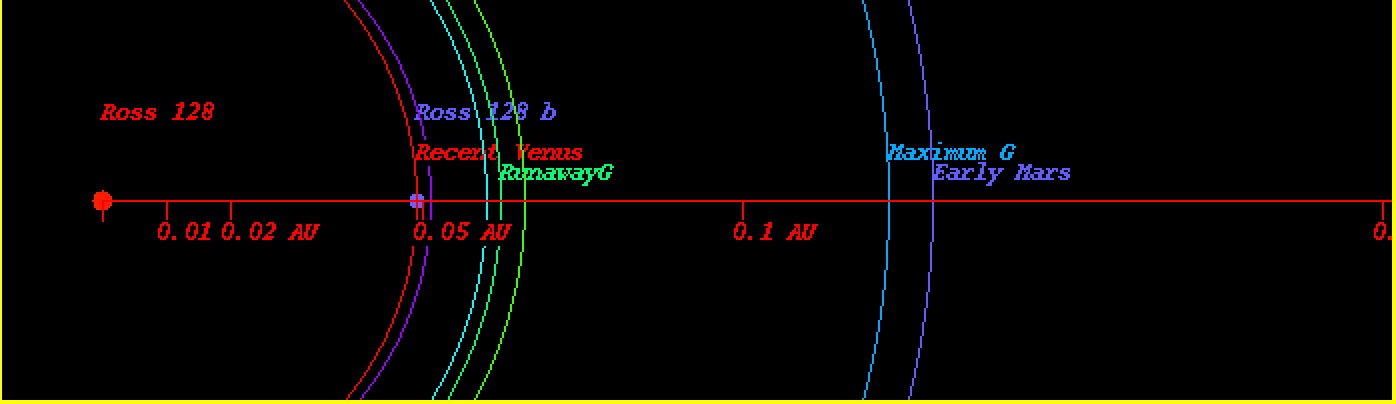
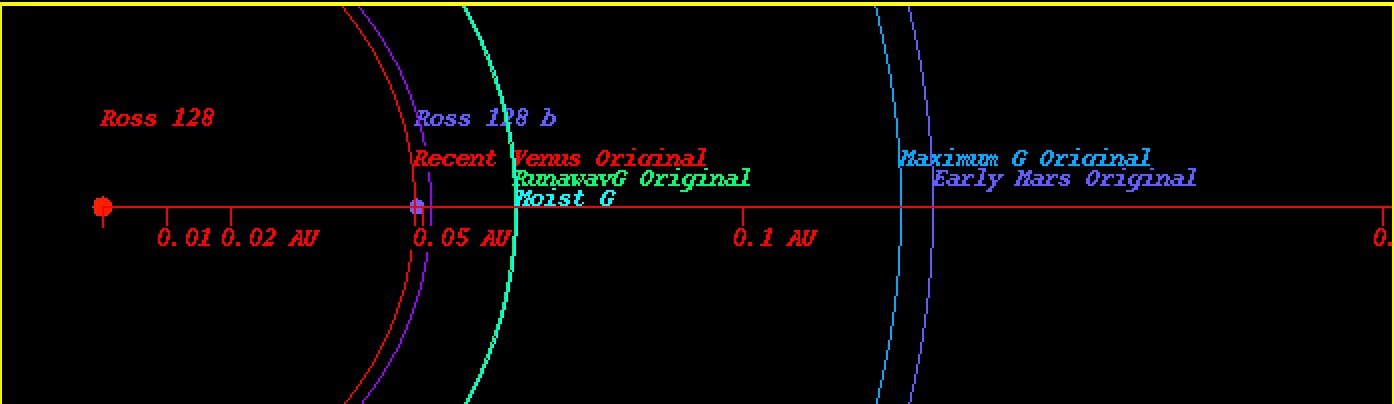
According to ExoKyoto, Ross 128b is calculated to be slightly inside the habitable zone limits.

The Habitable Zone Orbits of Ross 128 b (Proxima Vir b) (Kopparapu et al.)
According to ExoKyoto, Ross 128b is calculated to be slightly inside the habitable zone limits.

Ross 128 b (Proxima Vir b) Size Comparison

Ross 128 b (Proxima Vir b) Stellar Window Location

Ross 128 b (Proxima Vir b) Stellar Window Location