CoRoT-27 b

CoRoT-27 b

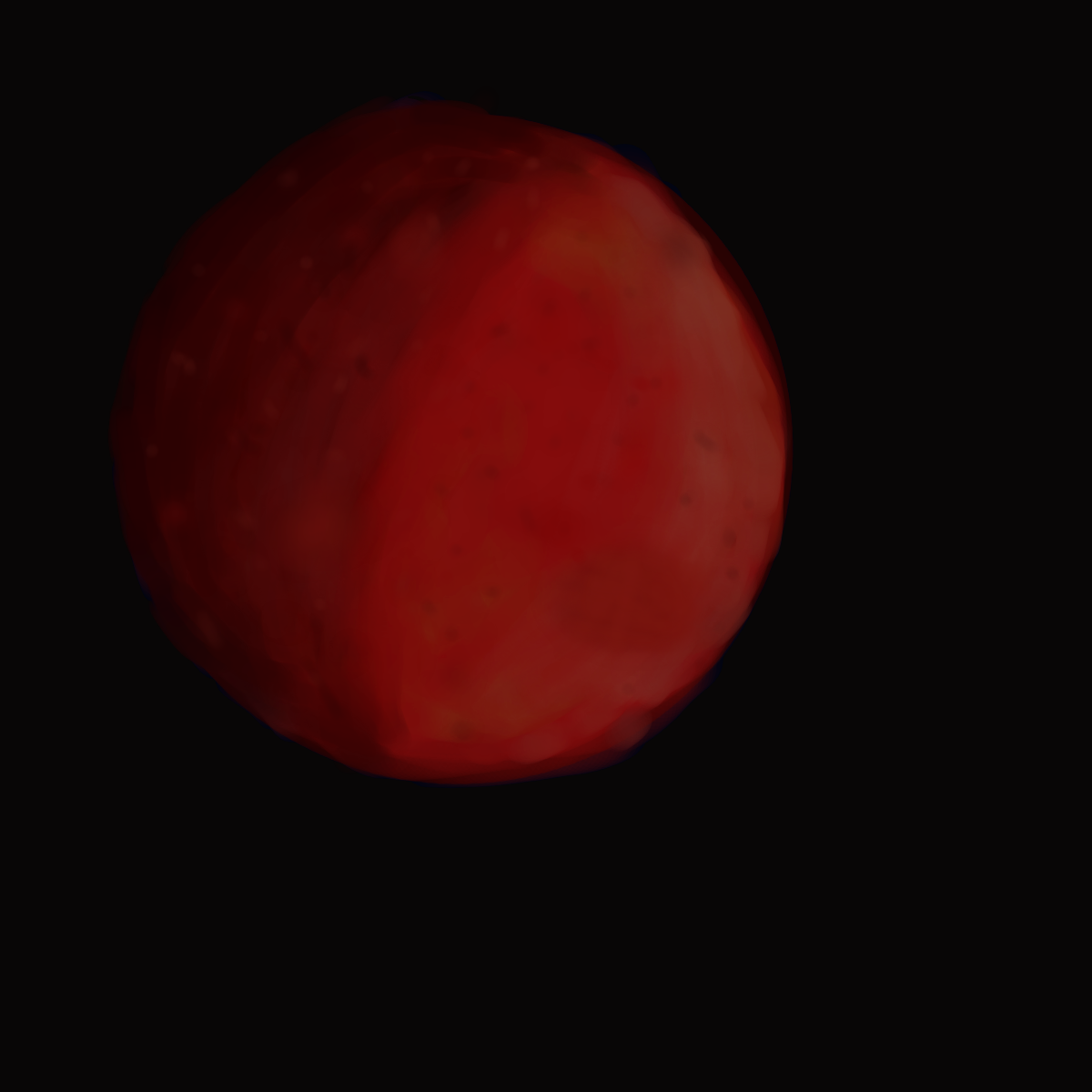
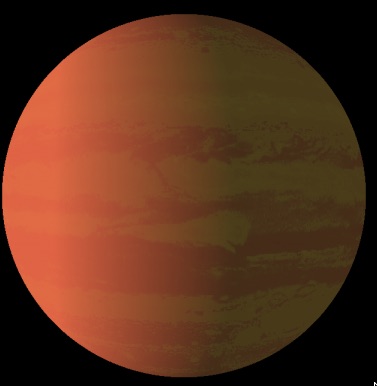
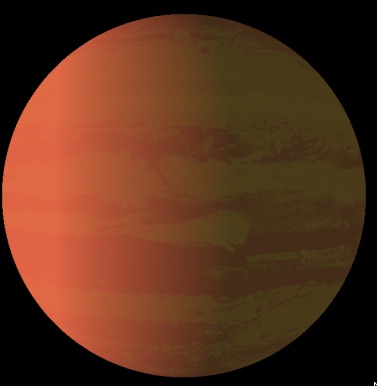
Parviainen H. et al. (2014) reported the discovery of a massive high-density planet on a close-in 3.58 day orbit around a 4.2 billion-year-old Sun-like star. The planet has been identified as CoRoT-27b. Like Jupiter, CoRoT-27b is a gas-giant. It was detected by the CoRoT space telescope using the transit method, in which a planet periodically transits its host star and blocks a small fraction of the star’s light. CoRoT-27b weighs in at 10.39 ± 0.55 Jupiter-mass and has 1.01 ± 0.04 times the radius of Jupiter. This gives CoRoT-27b a mean density of 12.6 times the density of water, which is more than twice the mean density of Earth and almost 10 times the mean density of Jupiter.

Like Jupiter, CoRoT-27b is a gaseous planet comprised primarily of hydrogen and helium. The structure and composition of CoRoT-27b can be inferred from two models. For the first model, the planet is assumed to be made of a central rocky core surrounded by an extensive hydrogen-helium envelope. The first model is consistent with a heavy element mass fraction of 0.11, representing a core mass of 366 Earth-masses. For the second model, a central rocky core is absent and the heavy elements are present throughout the hydrogen-helium envelope. The second model is consistent with a heavy element mass fraction of 0.07, representing a heavy element mass of 219 Earth-masses.

Given its high mass, gravity on the surface of CoRoT-27b is 27 times the surface gravity on Earth. Technically, CoRoT-27b does not have a surface since it is gaseous throughout, right down to a central rocky core, if one is present. Being so near its host star, the equilibrium temperature on CoRoT-27b is estimated to be 1500 ± 130 K. The discovery of CoRoT-27b is an important addition to a scarcely populated class of massive close-in planets.

The host star CoRoT 27 has an apparent magnitude of 15.5, with an absolute magnitude of 25.00. It is 1.05 times more massive and 1.08 times larger compared to our sun. The surface temperature is 5900 K and it has a spectral type of G2. In this planetary system, the extrasolar planet CoRoT 27 b orbits around the star CoRoT 27 at an orbital distance of 0.0476.
Journal Articles

1.) Transiting exoplanets from the CoRoT space mission XXV. CoRoT-27b: a massive and dense planet on a short-period orbit?


WEB Articles

1.) CoRoT-27b: A Massive and Dense Planet

2.) CoRoT-27b, a massive, dense planet on a short-period orbit about a G-type star.
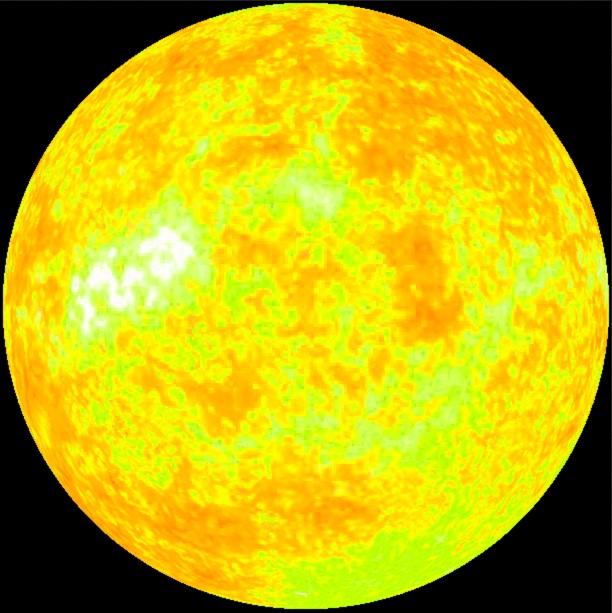
EPIC 220674823

Two transiting planets have been identified orbiting K2 target EPIC 220674823, or an alternative name, K2-106. One object is an ultra-short-period planet (USP) with an orbital period of just 0.57 days (13.7 hours), while the other has a period of 13.3 days. Both planets are small, with the former having a radius of Rp1 = 1.5 R and the latter Rp2 = 2.5 R. Follow-up observations, including radial velocity (with uncertainties of 110 ms 1 ) and high-resolution adaptive optics imagery, show no signs of stellar companions. EPIC 220674823 is the 12th confirmed or validated planetary system in which an ultra-short-period planet (i.e., having an orbital period less than 1 day) is accompanied by at least one additional planet, suggesting that such systems may be common and must be accounted for in models for the formation and evolution of such extreme systems.

For more information about EPIC 220674823, please visit the ExoKyoto database:

http://www.exoplanetkyoto.org/exohtml/EPIC_220674823.html

For more information about the exoplanets orbiting EPIC 220674823, please visit the following pages:

http://www.exoplanetkyoto.org/exohtml/K2-106_b.html

http://www.exoplanetkyoto.org/exohtml/K2-106_c.html

Journal Articles

1.) ULTRA SHORT PERIOD PLANETS IN K2 WITH COMPANIONS: A DOUBLE TRANSITING SYSTEM FOR EPIC 220674823

2.) The high-resolution cross-dispersed echelle white-pupil spectrometer of the McDonald Observatory 2.7-m telescope


WEB Articles

1.) EPIC 220674823

http://www.openexoplanetcatalogue.com/planet/EPIC%20220674823%20b/

GJ 9827 c

(Imaginary Picture of GJ9827 c: Ryusuke Kuroki, Fuka Takagi & Yosuke A. Yamashiki)

GJ9827 (also known as K2-135) is a K6 type star (with a surface temperature of 4255K, a mass and radius about 0.7 times that of our Sun) about 100 light-years away from the Earth. It was discovered by the transit method during the K2 mission (the second mission of the Kepler Space Telescope). Scientists found three Super-Earths (planets with a mass and radius several times that of the Earth) orbiting the star, reported in the Astronomical Journal published in February 2018. These three Super-Earths (GJ9827b, GJ9827c, GJ9827d in order of closeness to the host star) have radii of 1.62 times, 1.27 times, and 2.07 times the Earth, and their orbits around the host star are 1.2 days, 3.6 days, and 6.2 days, respectively.

The planet is a suitable candidate for more detailed observation of its planetary atmosphere using the James Web Space Telescope (JWST), which will be launched in a few years. These observations of Super-Earth atmospheres are said to be the key to understanding the atmospheric and internal structure of these types of planets, which are located at the boundary between the terrestrial planets (rocky planets) and gaseous planets, such as Jupiter. This is why the GJ9827 planetary system is so promising.

Journal Articles

1.) A System of Three Super Earths Transiting the Late K-Dwarf GJ 9827 at 30 pc

2.) Mass determination of the 1:3:5 near-resonant planets transiting GJ 9827 (K2-135)

3.) HD 106315 and GJ 9827: Understanding the Formation and Evolution of Small Planets


WEB Articles

1.) Planet GJ 9827 c

2.) THREE POSSIBLE SUPER-EARTHS DISCOVERED AROUND NEARBY SUN-LIKE STAR

3.) Planetary System GJ 9827, Secrets Of Far-Away Super-Earth

HAT-P-20b

HAT-P20b orbits  its host star at around P = 2.875317 ± 0.000004d, transit epoch Tc = 2455080.92661 ± 0.00021 (BJDUTC), with a transit time of 0.0770 ± 0.0008d. It orbits a medium bright V = 11.339 K3 dwarf GSC 1910-00239. The host star has a mass of 0.76 ± 0.03M⊙, a radius of 0.69 ± 0.02R⊙, an effective temperature of 4595 ± 80K, and a metallicity of [Fe / H] = + 0.35 ± 0.08. The mass of the planet is 7.246 ± 0.187 MJ, with a radius of 0.867 ± 0.033 RJ, and an average density of 13.78 ± 1.50 g cm-3, which is the second-highest of all known exoplanets.

Journal Articles

1.) HAT-P-20b–HAT-P-23b: FOUR MASSIVE TRANSITING EXTRASOLAR PLANETS

WEB Articles

1.) Planet HAT-P-20 b

HATS-17b

HATS-17b is a warm planet with a mass close to that of  Jupiter, that orbits around a Sun-like star about once every 16.255 days. The host star of HATS-17b has ~1.13 times the mass and ~1.09 times the radius of the Sun. Additionally, the host star’s surface temperature is estimated to be 5846 ± 78 K and the luminosity is about 25 percent greater than the Sun. By measuring how much light the plant blocks when it transits its host star, the radius of HATS-17b is estimated to be 0.777 ± 0.056 times the radius of Jupiter.

When radial velocity measurements were used, HATS-17b seemed to be 1.338 ± 0.065 times the mass of Jupiter. Knowing the size and mass of the planet, the density of HATS-17b can be calculated and is found to be ~3.50 g/cm³, roughly 30 percent denser than aluminum. The density of HATS-17b is remarkably high for an object with its mass. For comparison, the mean density of Jupiter is 1.326 g/cm³.

Interior models of HATS-17b suggest that ~50 percent of the planet’s mass is composed of a massive core of heavier elements. This works out to be around 200 times the mass of Earth. The massive core of HATS-17b is consistent with the high metallicity of its parent star. A star’s metallicity refers to the abundance of elements heavier than hydrogen and helium. The host star of HATS-17b has roughly twice the metallicity of the Sun and a more metal-rich protoplanetary disk can form massive cores more efficiently.

The host star HATS-17 has an apparent magnitude of 12.4, with an absolute magnitude of 4.75. It is 1.13 times more massive and 1.09 times larger compared with our sun. The surface temperature is 5846 K with a spectral type of G. In this planetary system, the extrasolar planet HATS-17 b orbits around the star HATS-17 with its orbital distance of 0.1308.

Journal Articles

1.) HATS-17b: A TRANSITING COMPACT WARM JUPITER IN A 16.3 DAYS CIRCULAR ORBIT

WEB Articles

1.) HATS-17b is a Warm-Jupiter Denser than Aluminium

2.) Our research: HATS-17b: a transiting compact warm Jupiter in a 16.3 days circular orbit

HATS-41b

HATS-41b is an exoplanet of great interest to the scientific community. It is only 33 percent larger than Jupiter, but nearly 10 times more massive than the largest planet in our solar system. According to researchers, it is one of the most massive “Hot Jupiters” found to date. It also orbits the highest metallicity star that has been found to host a transiting planet. HATS-41b has an orbital period of 4.19 days, is located about 0.06 AU from its host star, and has an equilibrium temperature of 1,710 K.

The host star HATS-41 has an apparent magnitude of 17.7, with an absolute magnitude of 8.18. It is 1.50 times more massive and 1.71 times larger than our sun. The surface temperature is 6424 K and its spectral type is F7. In this planetary system, the extrasolar planet HATS-41 b orbits around the star HATS-41 with its orbital distance of around 0.0583.

Journal Articles

1.) HATS-39b, HATS-40b, HATS-41b, and HATS-42b: three inflated hot Jupiters and a super-Jupiter transiting F stars

WEB Articles

1.) Four new ‘hot Jupiter’ exoplanets discovered