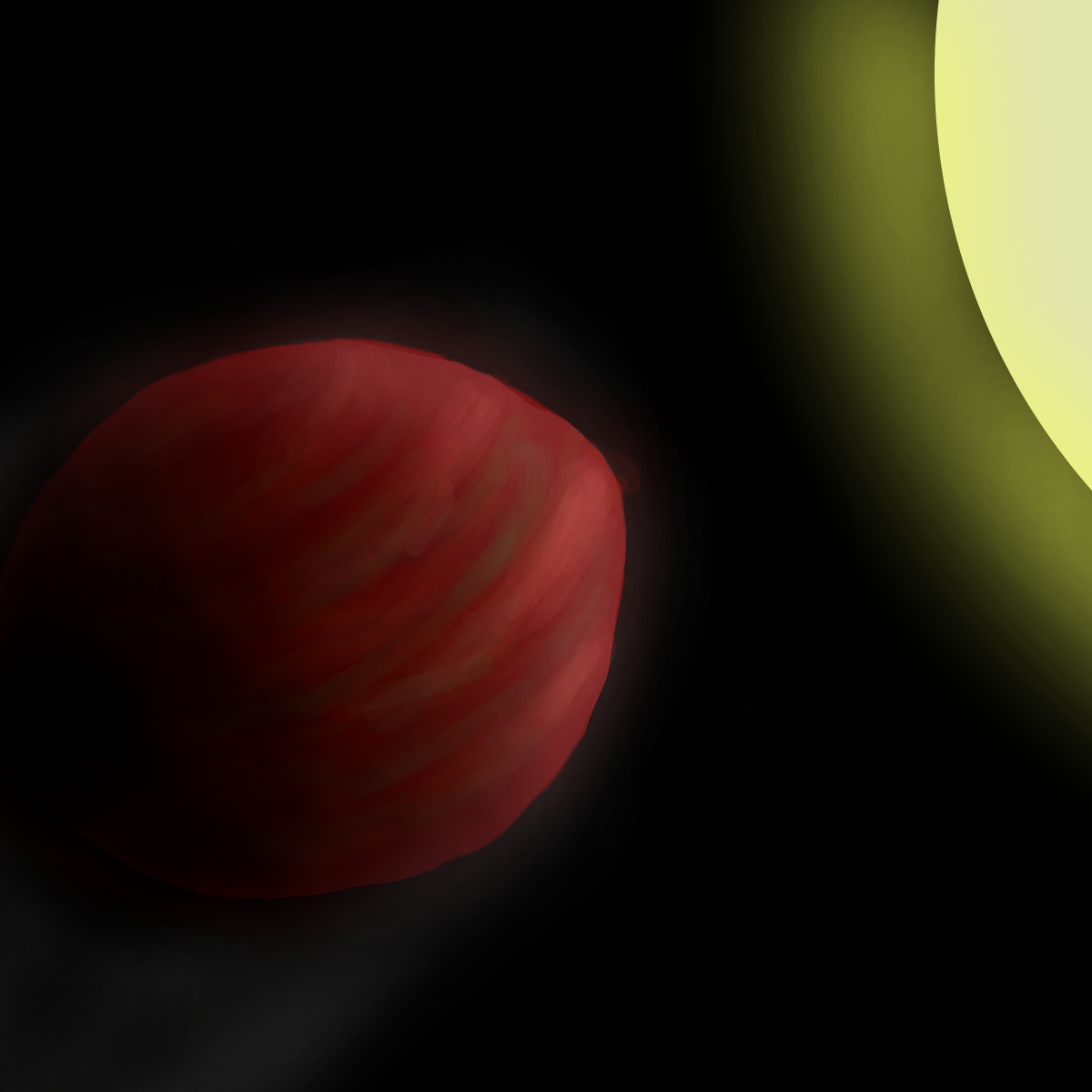
WASP-121 b is an exoplanet orbiting the star WASP-121, located 853.8 light-years (parsecs) from the Solar System, and was announced in 2015.
The star WASP-121 has an apparent magnitude of 10.4 and an absolute magnitude of 3.3.
This star has 1.4 times the mass of the Sun, 1.5 times its radius, a surface temperature of 6,460 K, and a spectral type of F6V.
In this star’s planetary system, WASP-121 b orbits WASP-121 with an orbital period of 1.3 days and a semi-major axis of 0.03 astronomical units (3,805,769.8 km).
It is a hot Jupiter with an orbital period nearly identical to its rotation period. Could the temperature difference between the day and night hemispheres cause rain of rubies or sapphires?
It was discovered in 2015 through observations by the SuperWASP exoplanet search project. It is a scorching giant gas planet located approximately 880 light-years from Earth in the direction of the constellation Lyra, orbiting the F-type main-sequence star WASP-121. It has about 1.2 times the mass of Jupiter and about 1.8 times its radius, orbiting at a very close distance of 3.8 million km from its star (WASP-121) in just over a day (about 30 hours). With a surface temperature of about 2,000 K and an upper atmosphere reaching about 2,500 K, it is one of the “hot Jupiters.” A distinctive feature is that its rotation period is nearly identical to its orbital period, resulting in a day side that always faces the star (while the other side, the night side, always faces away). Since temperatures exceed 1,500°C even on the night side, the clouds there are composed of metals such as iron, magnesium, chromium, and vanadium, rather than water clouds like those on Earth. In 2017, observations by the Hubble Space Telescope revealed that the atmosphere of WASP-121 b contains water vapor, vanadium(II) oxide, and titanium(II) oxide, making it almost certain that a stratosphere exists.
In 2019, due to its proximity to the star, WASP-121 b is believed to be on the verge of being torn apart by tidal forces, resulting in a football-like shape. David Sing and his team used observational data from the Space Telescope Imaging Spectrograph (STIS) aboard the Hubble Space Telescope to confirm that even metals such as iron and magnesium, which are condensed within the clouds, are flowing out into space along with lighter elements (hydrogen and helium).
In 2022, spectral analysis of both the day and night hemispheres of WASP-121 b using the Hubble Space Telescope revealed a water cycle different from Earth’s. In the day hemisphere, which always faces the star, the temperature in the upper atmosphere exceeds 3,000°C, causing water to evaporate and further decompose into hydrogen and oxygen. In contrast, temperatures in the upper atmosphere of the night side drop to 1,500°C. This 1,500°C temperature difference between the day and night sides generates strong winds that carry hydrogen and oxygen to the night side. There, the hydrogen and oxygen recombine to form water vapor, which is then blown back to the day side, creating a cycle. According to astrophysicist Tansu Daylan, these strong winds are believed to be capable of moving clouds across the entire planet in about 20 hours. While various metallic elements (vanadium, iron, chromium, calcium, sodium, magnesium, nickel, etc.) have been confirmed on WASP-121 b, aluminum and titanium were not detected. The research team speculates that this is because aluminum and titanium have condensed and rained down onto the surface. When aluminum combines with oxygen in the atmosphere, it forms a mineral called “corundum.” If corundum contains impurities such as chromium, iron, titanium, or vanadium, it becomes ruby or sapphire. Therefore, the night side of WASP-121 b may be covered in liquid ruby or sapphire.
Delrez, L. et al. (2016). “WASP-121 b: a hot Jupiter close to tidal disruption transiting an active F star”. Monthly Notices of the Royal Astronomical Society 458 (4): 4025-4043. arXiv:1506.02471. Bibcode: 2016MNRAS.458.4025D. doi:10.1093/mnras/stw522. ISSN 0035-8711.
Evans, Thomas M. et al. (2017). “An ultrahot gas-giant exoplanet with a stratosphere”. Nature 548 (7665): 58-61. arXiv:1708.01076v1. Bibcode: 2017Natur.548…58E. doi:10.1038/nature23266. ISSN 0028-0836.
David K. Sing. et al. (2019). “The Hubble Space Telescope PanCET Program: Exospheric Mg ii and Fe ii in the Near-ultraviolet Transmission Spectrum of WASP-121b Using Jitter Decorrelation”.The Astronomical Journal, Volume 158, Number 2, https://iopscience.iop.org/article/10.3847/1538-3881/ab2986/pdf
Mikal-Evans, T., Sing, D.K., Barstow, J.K. et al. Diurnal variations in the stratosphere of the ultrahot giant exoplanet WASP-121b. Nat Astron 6, 471–479 (2022).https://doi.org/10.1038/s41550-021-01592-w An exotic water cycle and metal clouds on the hot Jupiter WASP-121 b | Max Planck Institute for Astronomy (mpia.de)
(文責:小川)
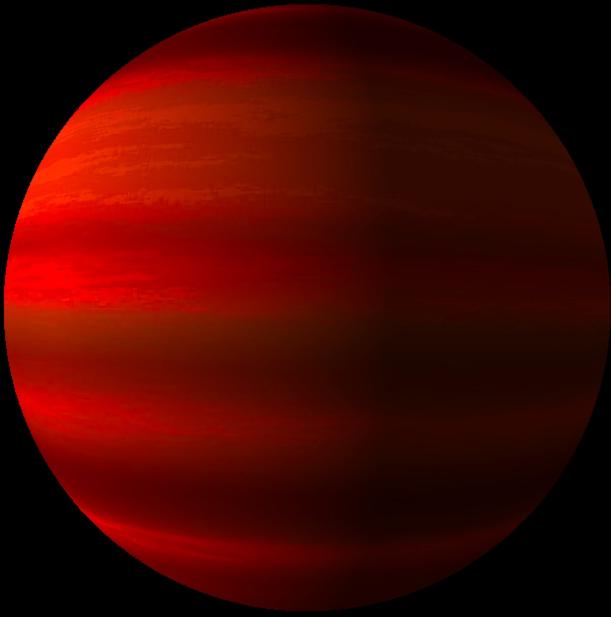
Imaginary picture of WASP-121 b
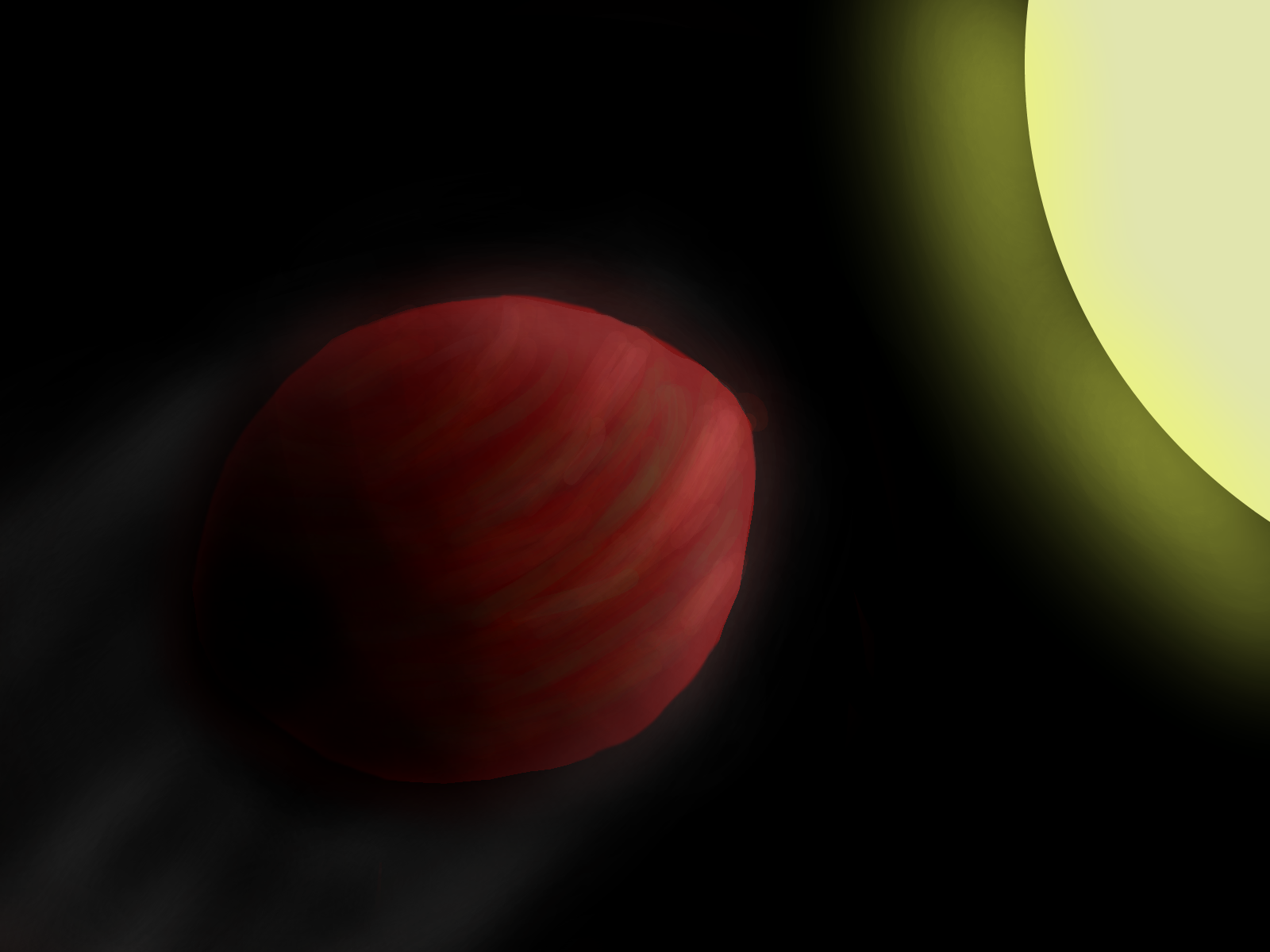
Imaginary Picture of WASP-121 b: Illustrated by Yuna Watanabe

