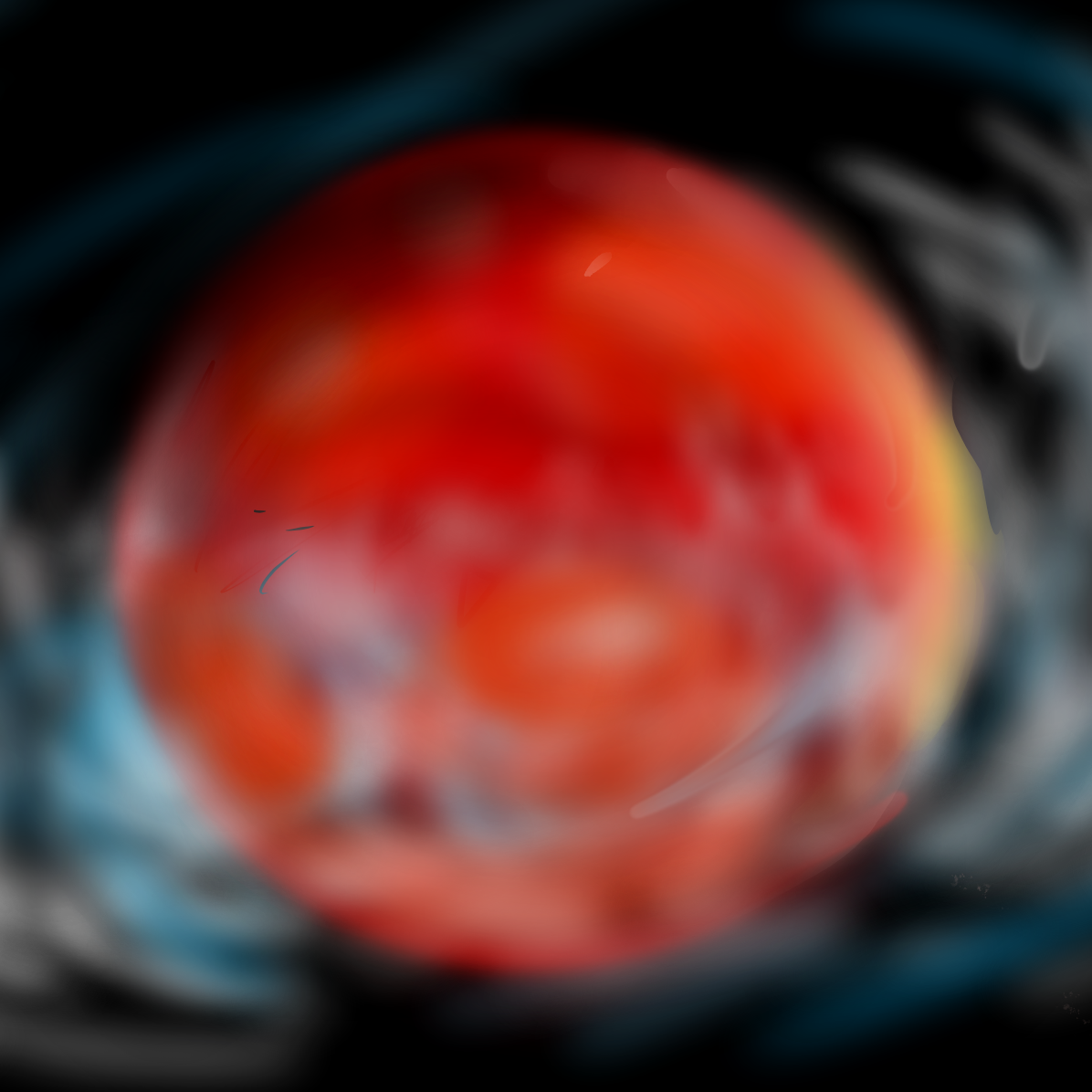
AB Aur b is an exoplanet orbiting the star AB Aur, located 469.7 light-years (parsecs) from the Solar System, and was announced in 2008.
The star AB Aur has an apparent magnitude of 7.1 and an absolute magnitude of 1.3.
This star has 2.4 times the mass of the Sun, a radius 1.7 times that of the Sun, a surface temperature of 9,600 K, and a spectral type of A0V.
A first in history: Direct imaging of a baby planet. A protoplanet that continues to grow even now.
In Japanese, it is referred to as “AB Aurorae b.” It is a protoplanet located within the gas disk of AB Aurorae, a young star (an Ae/Be-type star) believed to be only about 2 million years old. It is approximately 508 light-years from Earth and orbits at a distance of about 93 astronomical units from its host star (AB Aurorae). Its mass is predicted to be 9 to 12 times that of Jupiter, and its radius is estimated to be about 2.75 times that of Jupiter.
In 2022, a research group led by Thayne Currie of the National Astronomical Observatory of Japan’s Hawaii Observatory announced that they had successfully imaged a protoplanet in the very process of forming using the Subaru Telescope and the Hubble Space Telescope. This is believed to be the first time in history that a protoplanet, still existing within the gas and dust that will eventually form a planet, has been discovered through imaging.
Furthermore, in contrast to the “core accretion model”—in which dust gradually aggregates to form a planet within a typical protoplanetary disk—a different process known as the “disk self-gravity instability model” was proposed. This model suggests that at distances exceeding 50 astronomical units from the star, a portion of the protoplanetary disk splits and contracts under its own gravity, leading to relatively rapid planet formation. This provided important insights into theories of planet formation.
The Subaru Telescope’s SCExAO (SCExAO) and CHARIS are state-of-the-art instruments designed to observe exoplanets and disks around stars. By combining the two, it is possible to image celestial objects with high contrast while simultaneously observing their spectra. SCExAO features an extreme adaptive optics system that produces sharp stellar images, while CHARIS possesses a surface spectroscopy capability that allows it to acquire the spectra of individual points across a tiny area of the sky all at once.
This planet was first detected in 2016, but it was not considered a newly formed planet; rather, it was identified as part of the protoplanetary disk of “AB Aurorae.” However, subsequent SCExAO/CHARIS data obtained with the Subaru Telescope showed that the spectrum of AB Aurigae b differs from that of the protoplanetary disk and that its temperature is similar to the predicted value for a newly formed planet. This confirmed evidence that AB Aurigae b is orbiting AB Aurigae and is not a background star or other object.
Currie, T., Lawson, K., Schneider, G. et al. Images of embedded Jovian planet formation at a wide separation around AB Aurigae. Nat Astron 6, 751–759 (2022). https://doi.org/10.1038/s41550-022-01634-x
天文学:木星型の太陽系外惑星の形成過程が観測された | Nature Astronomy | Nature Portfolio (natureasia.com)
Hurley, Timothy (April 9, 2022). “Mauna Kea scientists discover emerging planet”. Honolulu Star-Advertiser.
(文責:小川)
For more information on AB Aurigae b:

