
ファイル 編集 表示 挿入 フォーマット ツール テーブル 段落
HD 104985 b is an exoplanet orbiting the star HD 104985, located 316.7 light-years (parsecs) from the Solar System, and was announced in 2003. The star HD 104985 has an apparent magnitude of 5.8 and an absolute magnitude of 0.9. This star has 1.6 times the mass of the Sun, a radius 10.9 times that of the Sun, a surface temperature of 4,786 K, and a spectral type of G9 III. In this star’s planetary system, HD 104985 b orbits the star with an orbital period of 199.5 days and a semi-major axis of 0.95 astronomical units (142,117,977.2 km).
[HD 104985 b Overview]
HD 104985 is a 6th-magnitude star (apparent magnitude) in the constellation Camelopardalis, located approximately 317 light-years from Earth. HD 104985 b is a planet with an orbit slightly less than one astronomical unit from this star. HD 104985 b has a radius nearly identical to Jupiter’s and a mass 8.3 times that of Jupiter. To draw an analogy with our solar system, HD 104985 b is a Jupiter-sized planet located between the orbits of Venus and Earth. Although it orbits at a distance roughly equivalent to Earth’s, the central star is extremely massive, so the environment is believed to be scorching hot.
[The First Exoplanet Detected in Japan: Demonstrating Japan’s Unique Contribution to the World]
HD 104985 b was detected using the radial velocity method with the 188-cm reflecting telescope owned by the Okayama Astrophysical Observatory and was announced in 2003 by Fumie Sato (then affiliated with the National Astronomical Observatory of Japan; now at Tokyo Institute of Technology) and his colleagues. This was the first detection of an exoplanet in Japan and attracted significant attention both domestically and internationally. Since the world’s first observation of an exoplanet in 1995, a fierce “planet-hunting race” had been underway worldwide, and Japan had now joined the fray.
While previous observations had targeted stars similar to the Sun, Sato and his team began searching for planets around giant stars—stars that have evolved and expanded significantly in size. In fact, HD 104985 has a radius 10.6 times that of the Sun and was one of the giant stars Sato and his team had identified as a candidate for observation. After two years of persistent observation, they successfully proved that exoplanets exist even around giant stars, demonstrating Japan’s unique contribution to exoplanet research.
[The Okayama Astrophysical Observatory’s 188-cm Reflecting Telescope: A Telescope That Supported Astronomical Observations in Japan for Half a Century]
The Okayama Astrophysical Observatory, one of the projects of the National Astronomical Observatory of Japan, began operations in Asakuchi City, Okayama Prefecture, in 1962. Until 2018, when operations as a project came to an end, it served as an outstanding optical and infrared astronomical observatory for approximately 56 years, utilized by many researchers. The observatory’s largest telescope is the 188-cm reflector, which has contributed to numerous significant discoveries. Its contributions to the discovery of exoplanets have been particularly notable; including joint observations with other telescopes, it has contributed to the discovery of 58 new exoplanets to date.
(For details on the 188cm telescope’s overview and achievements, please refer to this page.)
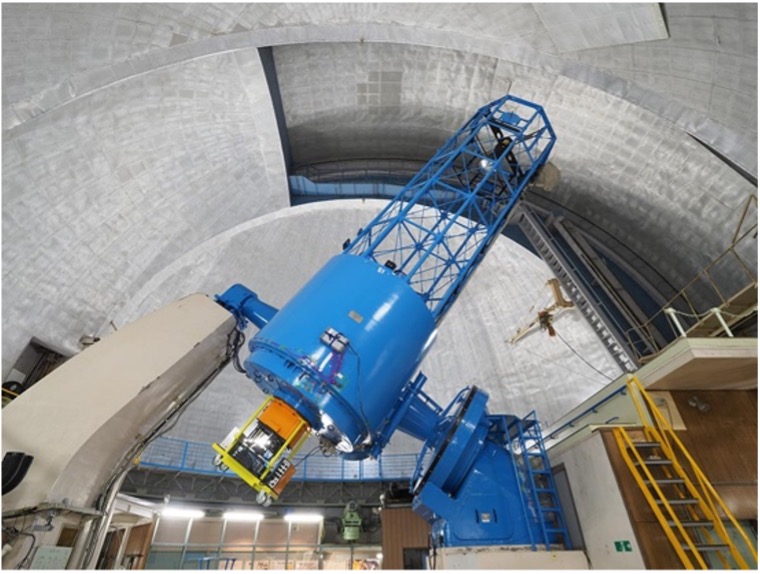
188-cm reflector telescope(https://www.nao.ac.jp/research/telescope/188cm.html)
After the project concluded, the telescopes at the Okayama Astrophysical Observatory were transferred to researchers from the participating universities to serve as their dedicated instruments. Currently, the 188-cm reflecting telescope is out of service due to a dome malfunction. Let’s look forward to the day when restoration work is complete and we can once again see the 188-cm reflecting telescope back in action.
[Kyoto University Okayama Astronomical Observatory’s Seimei Telescope: One of the Largest Telescopes in East Asia]
Following in the footsteps of the 188-cm telescope, a new telescope began operations in Okayama in 2019. This is the Seimei Telescope, owned by Kyoto University. With a primary mirror consisting of an 18-element composite mirror with a diameter of 3.8 meters, it is the largest telescope in East Asia. (There are differing opinions as to whether it is the “largest” or “one of the largest.” Please refer here for details.)
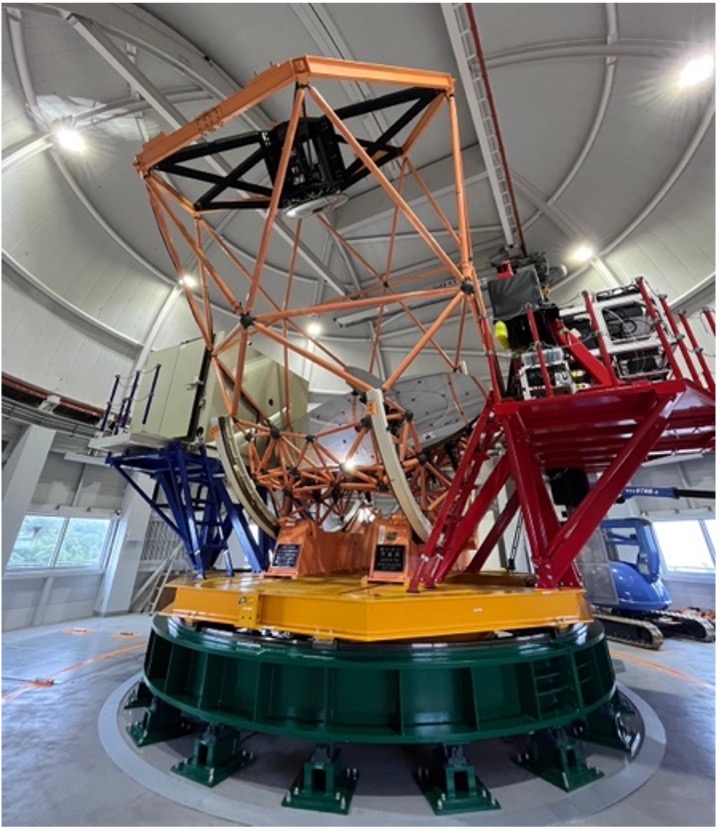
Seimei Telescope (Photo by the author)
The name “Seimei Telescope” is derived from Abe no Seimei, a Onmyōji (master of divination) from the Heian period. Abe no Seimei, who conducted astronomical observations throughout the country, is said to have established a residence for astronomical observation near the summit of Mt. Abe, located northwest of the current Okayama Astronomical Observatory. The telescope was named “Seimei Telescope” in honor of Abe no Seimei, a pioneer in astronomical research with ties to Okayama.
The Seimei Telescope is also used for the search for and observation of exoplanets, and a new high-dispersion spectrograph called GAOES-RV will begin operations in the second half of fiscal year 2023. A high-dispersion spectrograph is a device that separates the light collected by the telescope into its component wavelengths for detection; it is indispensable for observing exoplanets using the radial velocity method. With improved performance compared to previous high-dispersion spectrographs, GAOES-RV is expected to enable the observation of exoplanets around fainter stars.
(For more information on GAOES-RV, please click here.)
From Japan’s first detection of an exoplanet to the latest observational equipment, we’ve traced the history of exoplanet exploration. While the allure of exoplanets is endless, the telescopes and instruments used to discover them hold a unique charm of their own. If this has piqued your interest even a little, why not turn your attention not only to the star-studded night sky but also to the “big eyes” set up on the ground?
(文責:渡邊新)
Click here for detailed information on HD 104985 b

