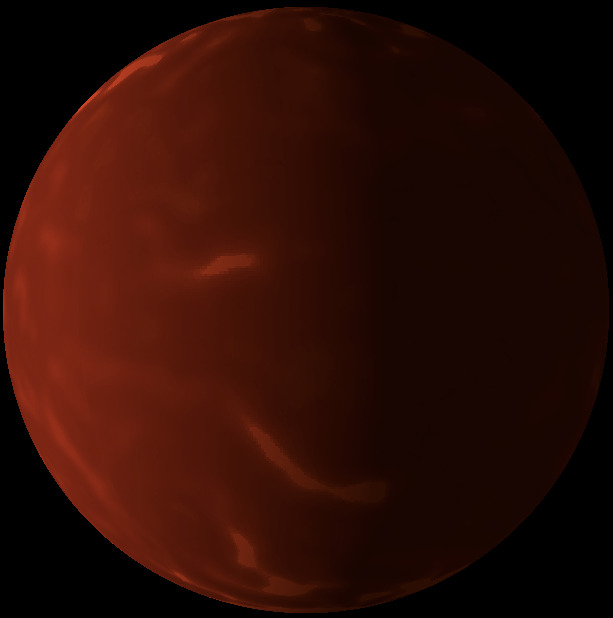
K2-141 b is an exoplanet orbiting the star K2-141, located 202.2 light-years (parsecs) from the Solar System, and was announced in 2018. The star K2-141 has an apparent magnitude of 11.5 and an absolute magnitude of 7.5. This star has 0.7 times the mass of the Sun, a radius of 0.7 times that of the Sun, a surface temperature of 4,599 K, and a spectral type of K4. In this star’s planetary system, K2-141 b orbits the star K2-141 with an orbital period of 0.3 days and a semi-major axis of 0.01 astronomical units (1,117,678.6 km).
K2-141 b is a Super Earth-sized exoplanet with a diameter approximately 1.5 times that of Earth and a mass approximately five times that of Earth. Its host star, K2-141, has a radius and mass both approximately 0.7 times that of the Sun and is located about 202 light-years from Earth. It has an orbital period of approximately 0.28 days and orbits at a semi-major axis of about 0.01 astronomical units. The inner boundary of the habitable zone around the host star K2-141 (the orbital radius where the planet receives Venus-like radiation) is 0.312 astronomical units, meaning that K2-141 b orbits well within the habitable zone.
According to a research group led by McGill University, K2-141 b is believed to be in a state of tidal locking, with its rotation and orbital periods synchronized. As a result, the temperature on the day side—which is constantly illuminated by the host star—is estimated to reach 3,000 degrees Celsius, while the temperature on the opposite night side is estimated to drop to minus 200 degrees Celsius; it is further estimated that a magma ocean approximately 100 kilometers deep covers the planet’s surface.
On the day side of this planet, temperatures are high enough to vaporize rock, so it is believed that substances that make up the rock—such as sodium, silicon monoxide, and silicon dioxide—vaporize and form the atmosphere. Simulations conducted by the research team predict that these substances are carried by the wind to the night side, where they cool and condense, falling as a “rock rain” into the magma ocean on the surface, thereby driving the rock cycle. However, the rate of this rock cycle is extremely slow, and as the planet’s composition changes over time, it may eventually develop a completely different atmosphere and surface. These simulation results are expected to be confirmed by the James Webb Space Telescope and may provide significant clues for understanding the temporal changes in rock composition on hot planets.
(文責:可児)
Click here for detailed information about K2-141 b

