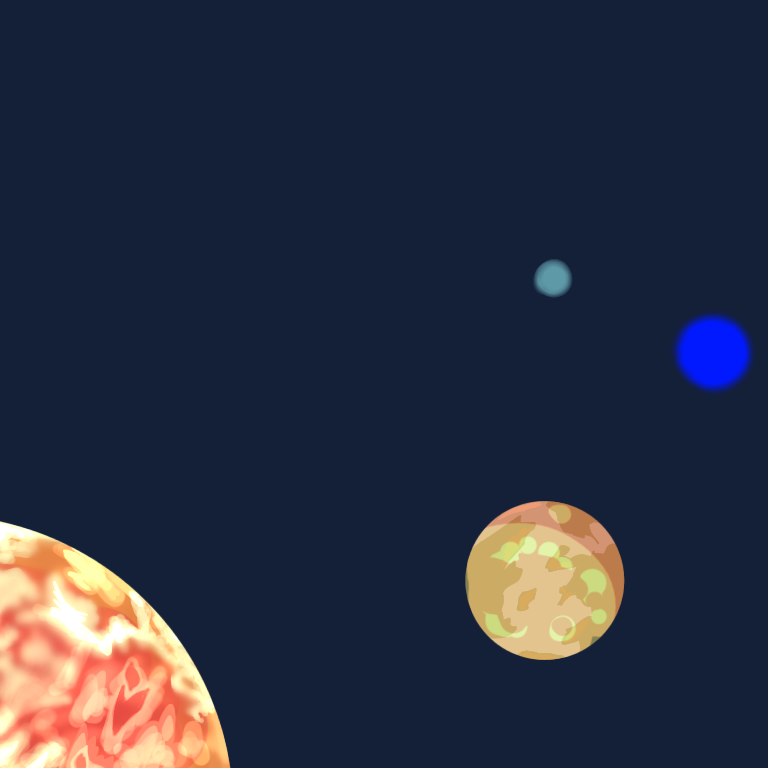
Imaginary picture of Kepler-1625 and its exoplanet (Yui Nagato)
Imaginary picture of Kepler-1625 b
Kepler-1625 b is an exoplanet orbiting the star Kepler-1625, located 7,587.4 light-years (parsecs) from the Solar System, and was announced in 2016. The star Kepler-1625 has an apparent magnitude of 14.4 and an absolute magnitude of 2.5. This star has 1.0 times the mass of the Sun, a radius 1.8 times that of the Sun, a surface temperature of 5,586 K, and a spectral type of G5. In this star’s planetary system, Kepler-1625 b orbits Kepler-1625 with an orbital period of 287.4 days and a semi-major axis of 0.84 astronomical units (1,257,744,156 km).
Kepler-1625 b is one of the 2,662 exoplanets discovered by NASA’s Kepler Space Telescope; it is a Jupiter-sized gas giant orbiting Kepler-1625, located 8,000 light-years from Earth. Although it is a gas giant and therefore not a habitable planet, it lies near the habitable zone.
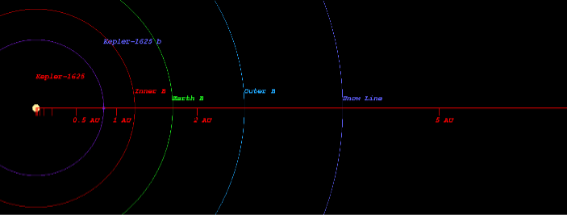
Credits: ExoKyoto(http://www.exoplanetkyoto.org/exohtml/Kepler-1625_bJP.html)
A detailed analysis of transit data from the Kepler Space Telescope revealed a faint transit signal immediately following the transit of Kepler-1625 b in 2018. Follow-up observations with the Hubble Space Telescope suggested that this signal might be a moon orbiting Kepler-1625 b, and it has been named Kepler-1625 b I as a candidate for an (exomoon) and has been named Kepler-1625 b I. However, because the transit signal from Kepler-1625 b I is faint, follow-up studies have pointed to the possibility that it could be experimental noise, and its existence has not yet been confirmed. It is hoped that detailed observations by the James Webb Space Telescope will lead to the confirmation of the first exomoon.
If Kepler-1625 b I exists, it is believed to be a Neptune-sized gas giant. Since it is a gas giant, a habitable environment is not expected on this moon; however, research using simulations on Kepler-1625 b and Kepler-1625 b I is ongoing, and it has been suggested that a moon the size of Earth may exist orbiting Kepler-1625 b I. That moon would be a rocky satellite and could be a habitable moon located near the habitable zone, raising hopes for the existence of extraterrestrial life.
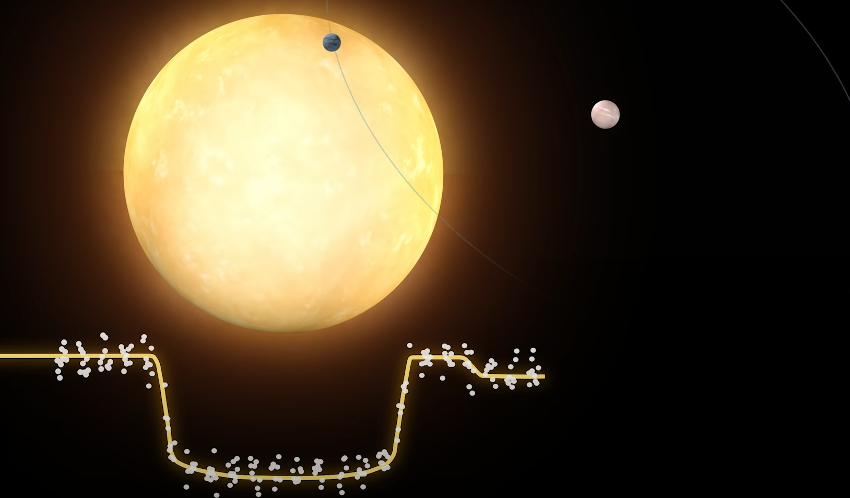 Credits: NASA
(https://exoplanets.nasa.gov/news/1525/new-moon-astronomers-find-first-evidence-of-a-possible-moon-outside-our-solar-system/)
The status of Kepler-1625 b I as a potential exomoon remains unconfirmed, and the idea of it having a moon is still purely speculative. However, if we consider our own solar system, we see that all planets except Mercury and Venus have moons, so I believe it’s safe to say that moons are a common feature among planets. I look forward to further observations by the James Webb Space Telescope confirming the first exomoon.
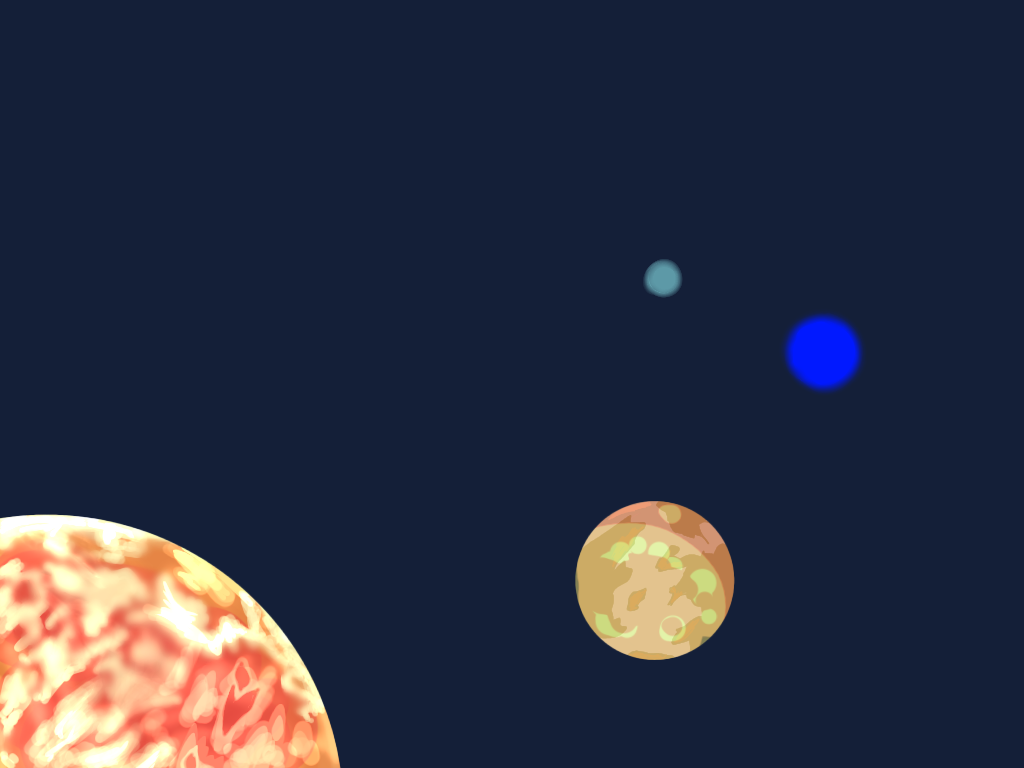
Artist’s concept of Kepler-1625, its planets, moons, and stars orbiting the moons (Yui Nagato)
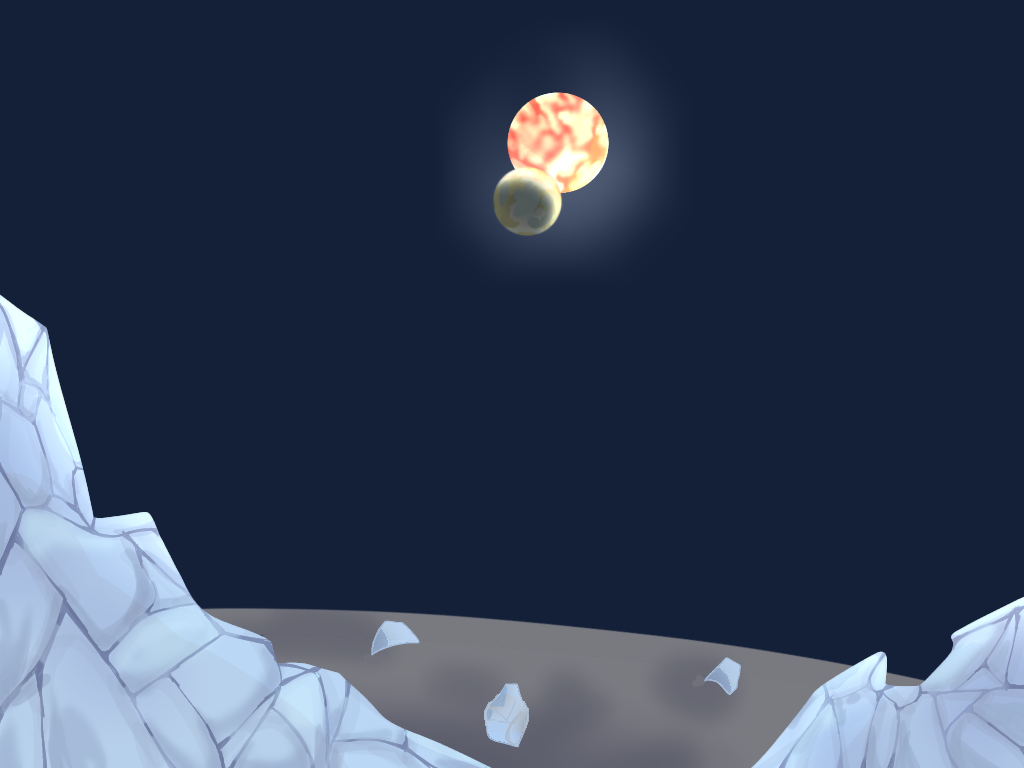
An artist’s concept of the planet Kepler-1625 b as seen from Earth, orbiting its moon (Yui Nagato)
(文責:小塚)
<References>
http://www.exoplanetkyoto.org/exohtml/Kepler-1625_bJP.html
https://academic.oup.com/mnras/article-abstract/510/2/2583/6498286?redirectedFrom=fulltext
https://arxiv.org/pdf/1810.02712.pdf
Click here for detailed information on Kepler-1625 b

