Category: Famous Exoplanets

Kepler-62 System

Kepler-62 is a five-planet system about 1,200 light-years from Earth in the constellation Lyra. The five planets of Kepler-62 orbit a star classified as a K2 dwarf, measuring just two thirds the size of the sun and only one fifth as bright. At seven billion years old, the star is somewhat older than the sun.

Much like our solar system, Kepler-62 is home to two habitable zone worlds, Kepler-62f and Kepler-62e. Kepler-62f orbits every 267 days and is only 40 percent larger than Earth, making it the smallest known exoplanet in the habitable zone of another star. The other exoplanet in the habitable zone is Kepler-62e, which orbits every 122 days and is roughly 60 percent larger than Earth.

The size of Kepler-62f is known, but its mass and composition are not. However, based on previous exoplanet discoveries of similar size that are rocky, scientists are able to determine its mass by association.

The two habitable zone exoplanets orbiting Kepler-62 have three interior companions, two larger than Earth and one about the size of Mars. Kepler-62b, Kepler-62c, and Kepler-62d orbit every five, 12, and 18 days, respectively, making them very hot and inhospitable for life as we know it.

Reference:

http://science.sciencemag.org/content/early/2013/04/17/science.1234702

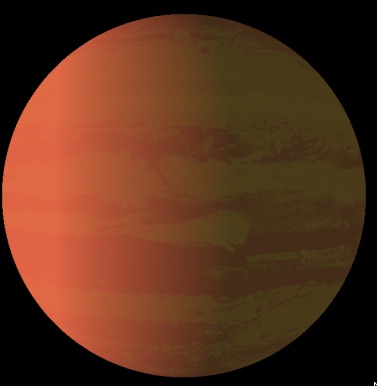
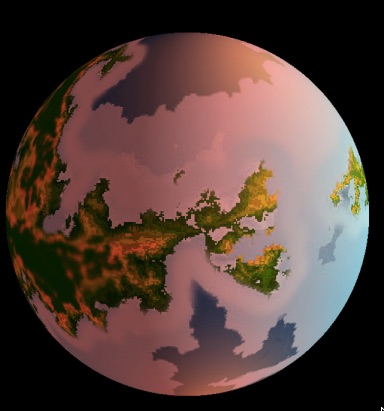
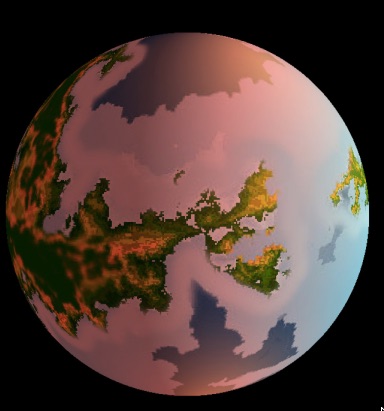
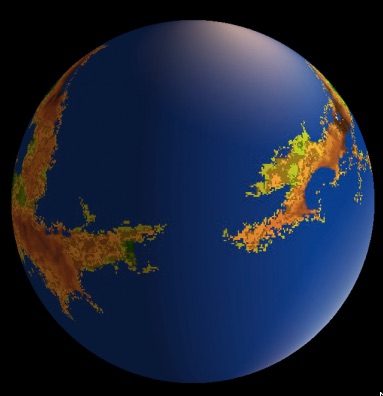
[Imaginary Picture of Kepler-62 e: Credit Fuka Takagi and Yosuke A. Yamashiki]
Journal Articles:

1.) Kepler-62: A Five-Planet System with Planets of 1.4 and 1.6 Earth Radii in the Habitable Zone

2.) Mercury-T: A new code to study tidally evolving multi-planet systems. Applications to Kepler-62

3.) Water-Planets in the Habitable Zone: Atmospheric Chemistry, Observable Features, and the case of Kepler-62e and -62f

WEB Articles

1.) The Math: What Life On Kepler-62e Would Be Like

2.) Kepler-62e

3.) Water Planets in the Habitable Zone: A Closer Look at Kepler 62e and 62f

Pi Mensae c

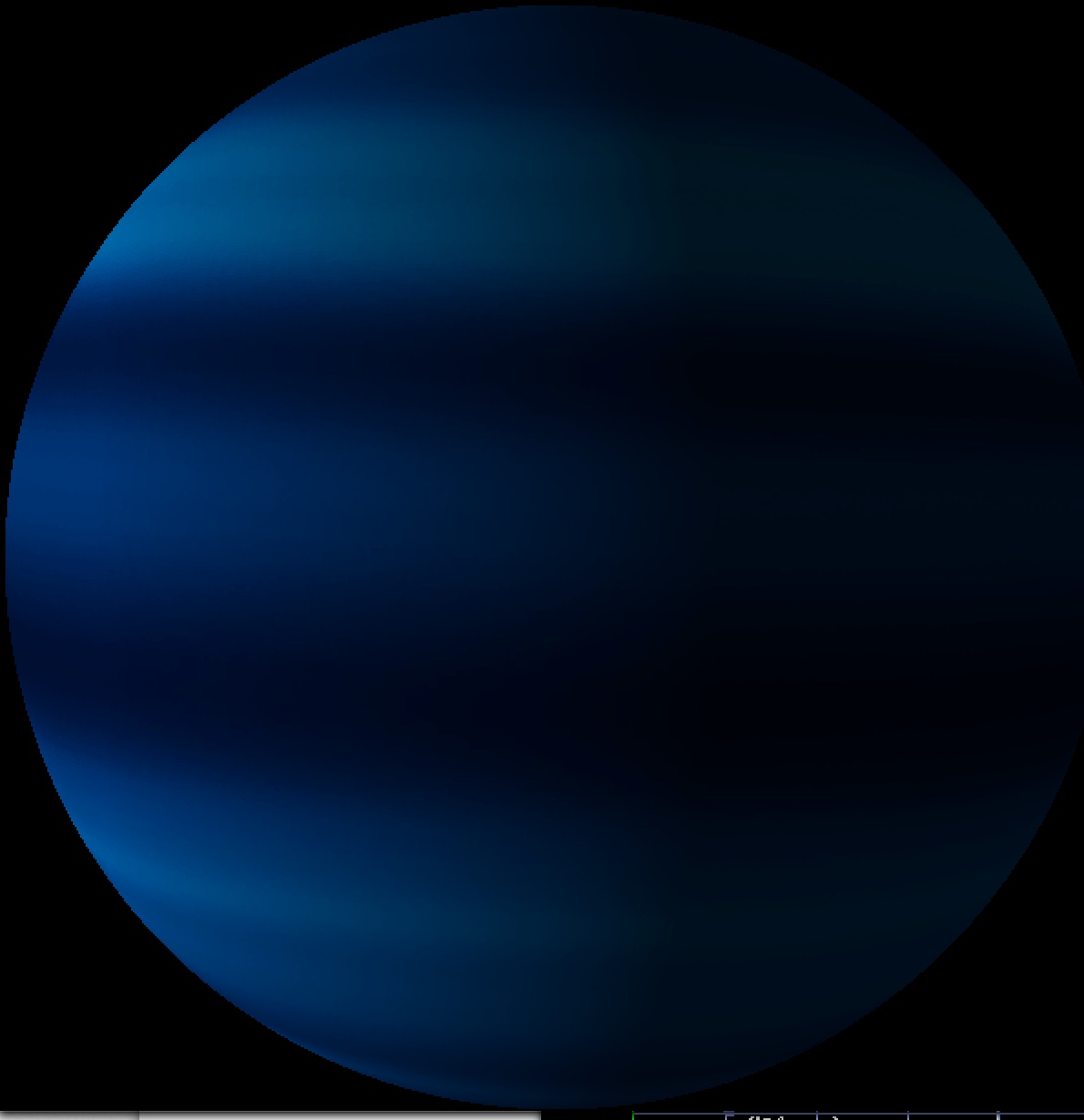
<Image of Pi Mensae c Exokyoto system automated selection, © 2018 ExoplanetKyoto- Ryusuke Kuroki, Yosuke A. Yamashiki and Natsuki Hosono>

Pi Mensae c orbits around a somewhat large and bright G-type star Pi Mensae, and is categorized as a Super Earth, with a radius of about two times that of Earth. This planet was first reported in arXiv in September 2018, the first exoplanet discovered by TESS, the Transiting Exoplanet Survey Satellite. Furthermore, another orbiting planet, Pi Mensae b was discovered in 2001 and was found to have a mass 10 times that of Jupiter.

<From the right: (1) our sun and Pi Mensae (HD 39091) (2) Jupiter (3) Earth and Pi Mensae comparison>

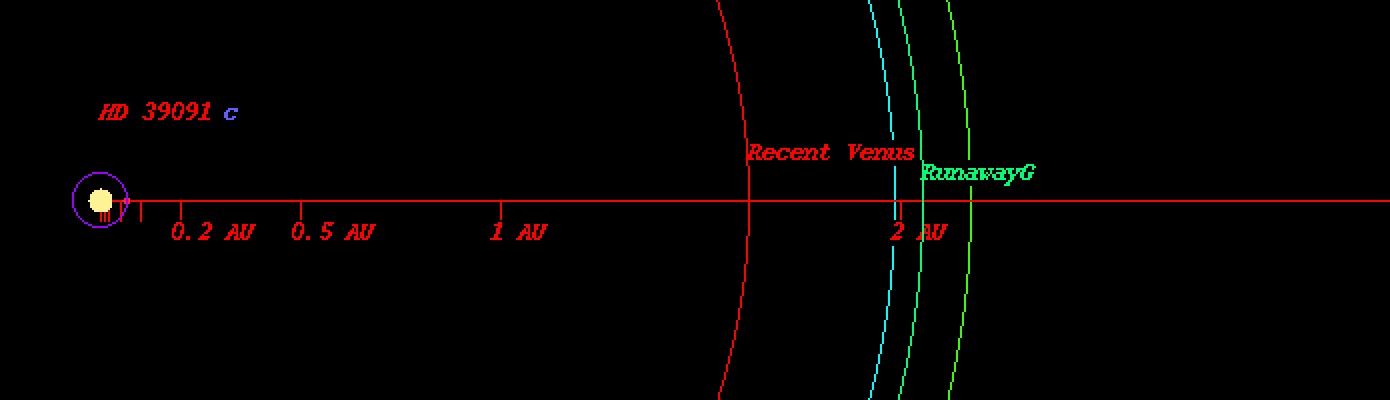
Pi Mensae c is thought to have a small mass relative to its size and be less dense than the Earth. Therefore, it is presumed to be a planet with a lot of water, or have a thick atmosphere. Also, since the distance from the host star is only about 1/50 of the distance from the sun to Mercury, water is thought to evaporate at very high temperatures on its surface.

<pi Mensae c (HD 39091 c) orbit, and the runaway greenhouse effect line (in green)>

Pi Mensae c is about 60 light-years away from the earth and the apparent magnitude is 5.67, so if you are in a very dark environment you can see it with the naked eye. If you are ever traveling in the southern hemisphere and see this star, you can tell everyone that “a Super Earth revolves around that star!”

For more information on Pi Mensae c, please see the ExoKyoto database:

http://www.exoplanetkyoto.org/exohtml/pi_Men_cJP.html

<Pi Mensae b>  Super Jupiter with an eliptical orbit.

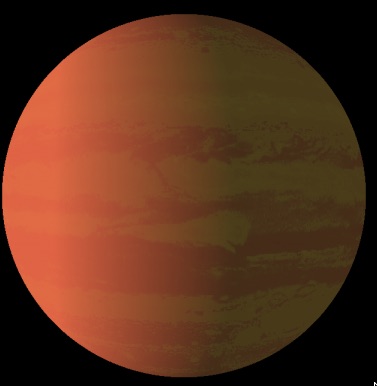
<Imaginary image of pi Mensae b Exokyoto system automated selection, – © 2018 ExoplanetKyoto – Ryusuke Kuroki, Yosuke A. Yamashiki and Natsuki Hosono>

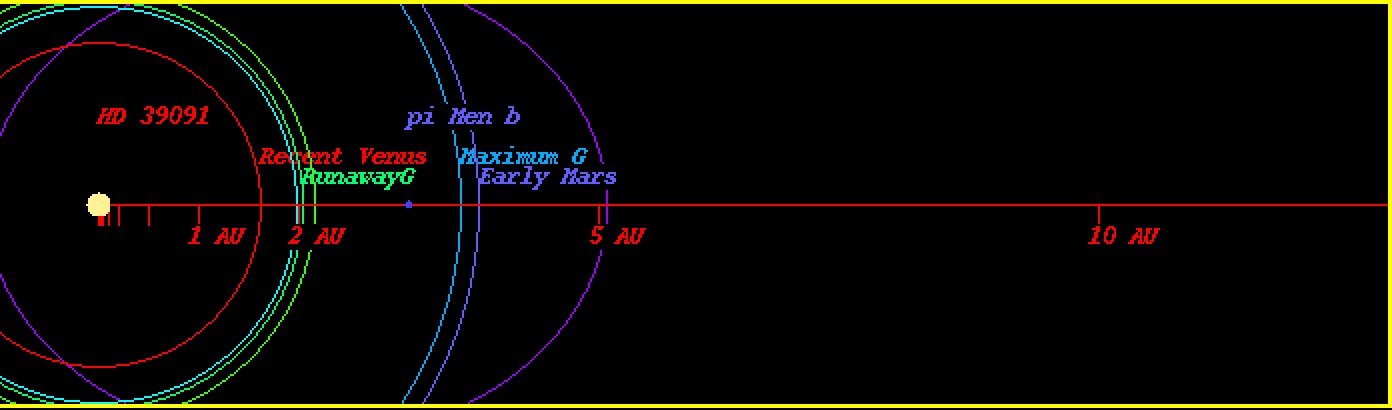
Two exoplanets have been discovered orbiting the main sequence star Pi Mensae (HD 39091), which is said to have a radius of 2.1 times the sun. The first, Pi Mensae b (HD39091b) was discovered in 2001. This planet is thought to have a mass of 10.02 times that of Jupiter, and it has an elliptical orbit of around 1-5 astronomical units from its host star. This orbit goes from just inside the Venus-equivalent orbit, to the outside of the habitable zone and takes about 2093 days. The radius of Pi Mensa b has yet to be accurately observed.

For more information on Pi Mensae b, please see the ExoKyoto database:

http://www.exoplanetkyoto.org/exohtml/pi_Men_bJP.html

<Elliptical orbit of Pi Mensae b (HD 39091 b)(purple line) and the habitable zone according to Kopparapu et al. 2013>

Mensa comes from the Latin meaning “table.” In Japanese, the Mensa constellation is “table-san” which translates to “table mountain.” Table Mountain (Mons Mensae in Latin), al plateau-like mountain overlooking the city in Cape Town, South Africa, which is a characteristic topography around the Cape of Good Hope. It is one of the 14 (12) constellations in the southern sky discovered by the French astronomer Abbé Nicolas-Louis de Lacaille.

A photo of Table Mountain for reference.

<Mons Mensae – Table Mountain, photo taken by Yosuke A. Yamashiki in 2000, © 2018 ExoplanetKyoto>>

Kepler-283 c

Kepler-283 c is located 1741.0 light-years (534 parsecs) from our solar system and was discovered in 2014 orbiting it’s host star Kepler-283. The apparent magnitude of the host star is 13.9 and the absolute magnitude is 5.3. Kepler-283 is about 0.8 the mass of our sun and has about 0.6 the radius. Its surface temperature is 4351 K and is a spectral K5 type star. The planet Kepler-283 c orbits the star every 92.7days, it’s orbital radius is 0.34 SEAU. 

According to an announcement from NASA, this planet is located in the habitable zone. ExoKyoto has come up with the same conclusion. Kepler-283 c is the only habitable planet in which superflares from the host star (Kepler-283) were observed during observation with the Kepler Space Telescope. Based on this, the estimated radiation exposure dose was calculated for various cases, taking into account the frequency of flares, but the doses were level and none caused problems (Yamashiki et al. 2019 ApJ).

A second planet, Kepler-283 b, has also been found in the Kepler-283 solar system, which is a Hot Jupiter located inside the habitable zone.

For more information on Kepler-283 c, please visit the ExoKyoto database page below. http://www.exoplanetkyoto.org/exohtml/Kepler-283_cJP.html

HATS-41b

HATS-41b is an exoplanet of great interest to the scientific community. It is only 33 percent larger than Jupiter, but nearly 10 times more massive than the largest planet in our solar system. According to researchers, it is one of the most massive “Hot Jupiters” found to date. It also orbits the highest metallicity star that has been found to host a transiting planet. HATS-41b has an orbital period of 4.19 days, is located about 0.06 AU from its host star, and has an equilibrium temperature of 1,710 K.

The host star HATS-41 has an apparent magnitude of 17.7, with an absolute magnitude of 8.18. It is 1.50 times more massive and 1.71 times larger than our sun. The surface temperature is 6424 K and its spectral type is F7. In this planetary system, the extrasolar planet HATS-41 b orbits around the star HATS-41 with its orbital distance of around 0.0583.

Journal Articles

1.) HATS-39b, HATS-40b, HATS-41b, and HATS-42b: three inflated hot Jupiters and a super-Jupiter transiting F stars

WEB Articles

1.) Four new ‘hot Jupiter’ exoplanets discovered

Kepler-440 b

Kepler-440 b is located 851.3 light-years (261 parsecs) from our solar system and was discovered in 2015 orbiting its host star Kepler-440. The apparent magnitude of the host star is 15.5 and the absolute magnitude is 8.4. Kepler-440 is about 0.6 the mass of our sun and has about 0.6 the radius. Its surface temperature is 4134 K and is a spectral K6 type star. The planet Kepler-440 b orbits the star every 101.1 days, it’s orbital radius is 0.24 SEAU.