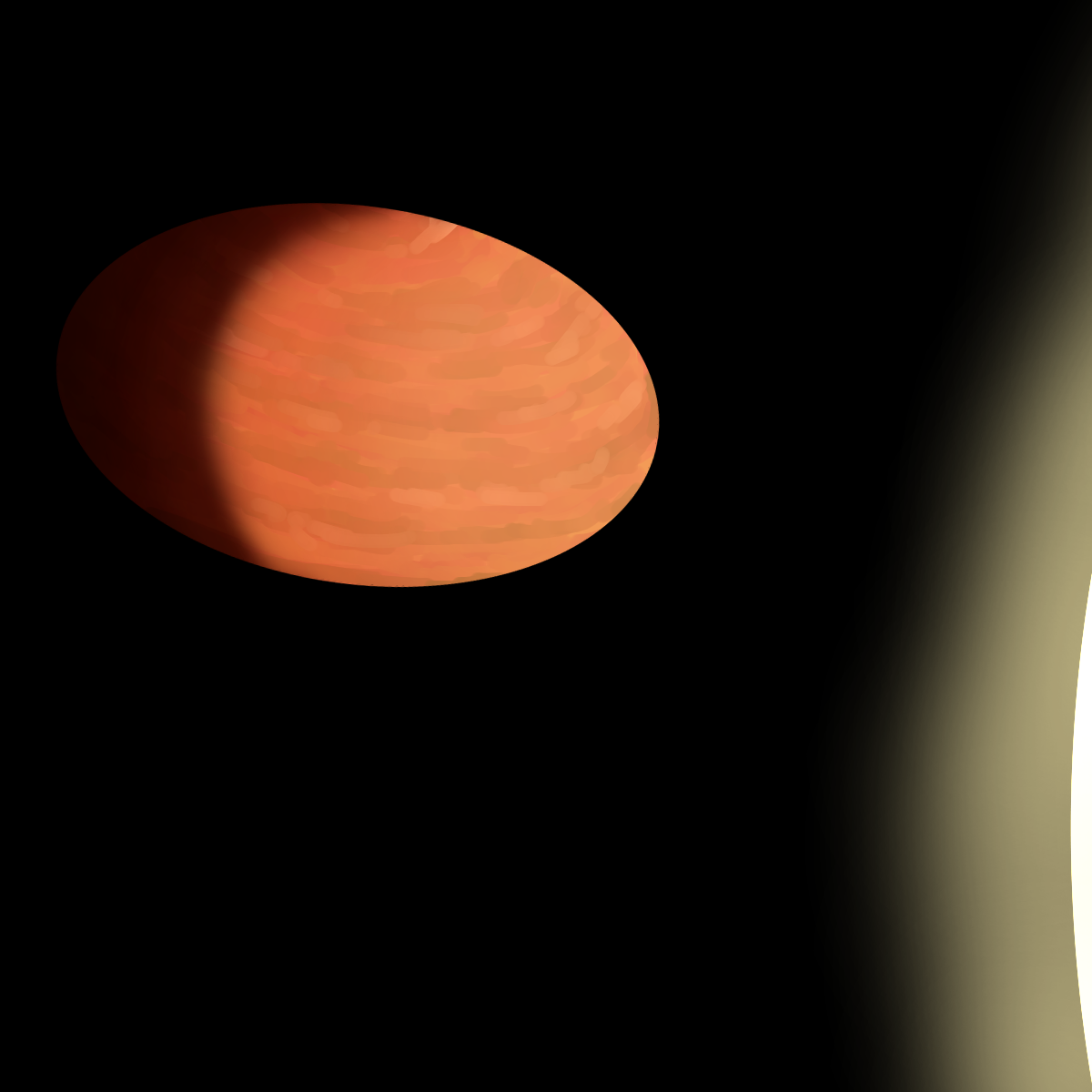
WASP-103 b
WASP-103 b is an exoplanet orbiting the star WASP-103, located 1,532.9 light-years (parsecs) from the Solar System, and was announced in 2014. The star WASP-103 has an apparent magnitude of 12.0 and an absolute magnitude of 3.6. This star has 1.2 times the mass of the Sun, a radius 1.4 times that of the Sun, a surface temperature of 6,110 K, and a spectral type of F8V. In this star’s planetary system, WASP-103 b orbits the star WASP-103 with an orbital period of 0.9 days and a semi-major axis of 0.02 astronomical units (2,969,517.7 km).
WASP-103 b is a hot Jupiter with a mass and radius approximately 1.5 times that of Jupiter. It is located approximately 1,533 light-years from the Solar System. The SuperWASP project suggested the presence of a planet around WASP-103, and it was subsequently discovered in 2014 using the transit method with the TRAPPIST telescope. Because its distance from its host star, WASP-103 (an F-type star), is only about 0.02 AU, its estimated blackbody temperature is quite high at approximately 2,440 K, and it completes an orbit in less than a day. Additionally, WASP-103 b is believed to have a lower density (approximately 550 kg/m³) than estimated by standard hot Jupiter mass models. This is thought to be related to the fact that WASP-103 b receives an extremely high amount of radiation from its host star, and its orbital position is very close to the Roche limit (the boundary distance at which the host star’s tidal forces balance the gravitational pull between the star and the planet, preventing the planet from being torn apart), suggesting that it is on the verge of tidal disruption.
Other planets believed to be on the verge of tidal disruption include WASP-12 b, WASP-19 b, and OGLE-TR-56 b. These hot Jupiters in extreme states are considered crucial for understanding the fate of hot Jupiters and are currently the focus of attention.(文責:白樫聖夢)
References:
[1] M. Gillon et al. “WASP-103 b: a new planet at the edge of tidal disruption”. A&A. 2014/02/05.
https://www.aanda.org/articles/aa/pdf/2014/02/aa23014-13.pdf, (閲覧日: 2022/03/21)
[2] WASP 103 b, ExoKyoto,
http://www.exoplanetkyoto.org/exohtml/WASP-103_bJP.html, (閲覧日: 2022/03/18)
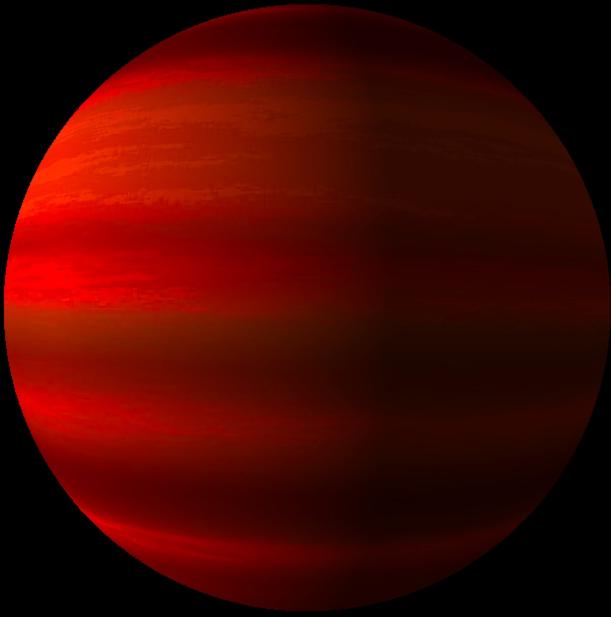 Imaginary Picture of WASP-103 b
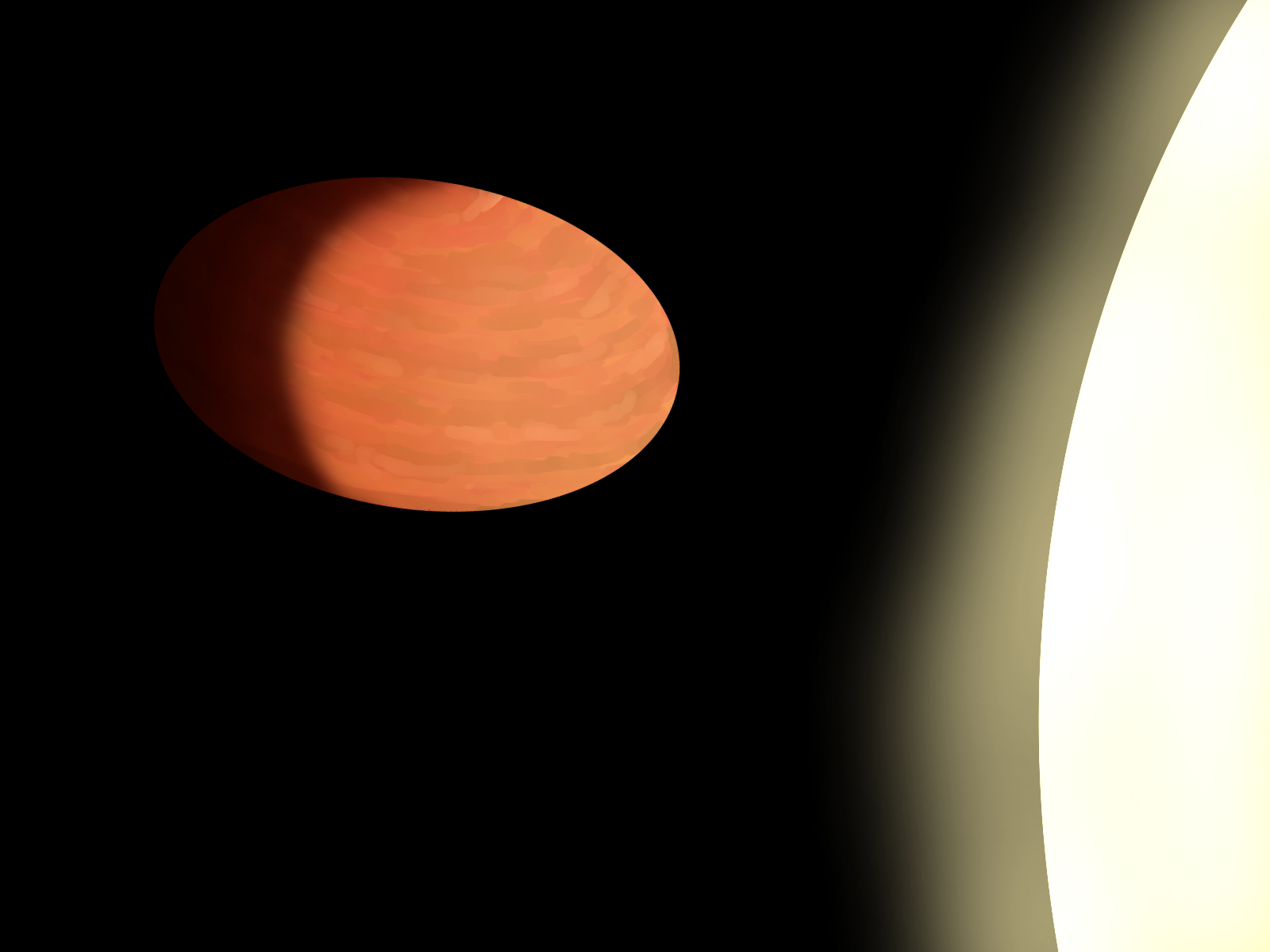
Imaginary picture of WASP-103 b (Image credit: Miu Shimizu)
For more information about WASP-103 b, please visit the following link:
http://www.exoplanetkyoto.org/exohtml/WASP-103_bJP.html